Continuing Your Education Through Co-Curriculars
Jan 20, 2026
By Coby Unger (The Shop)
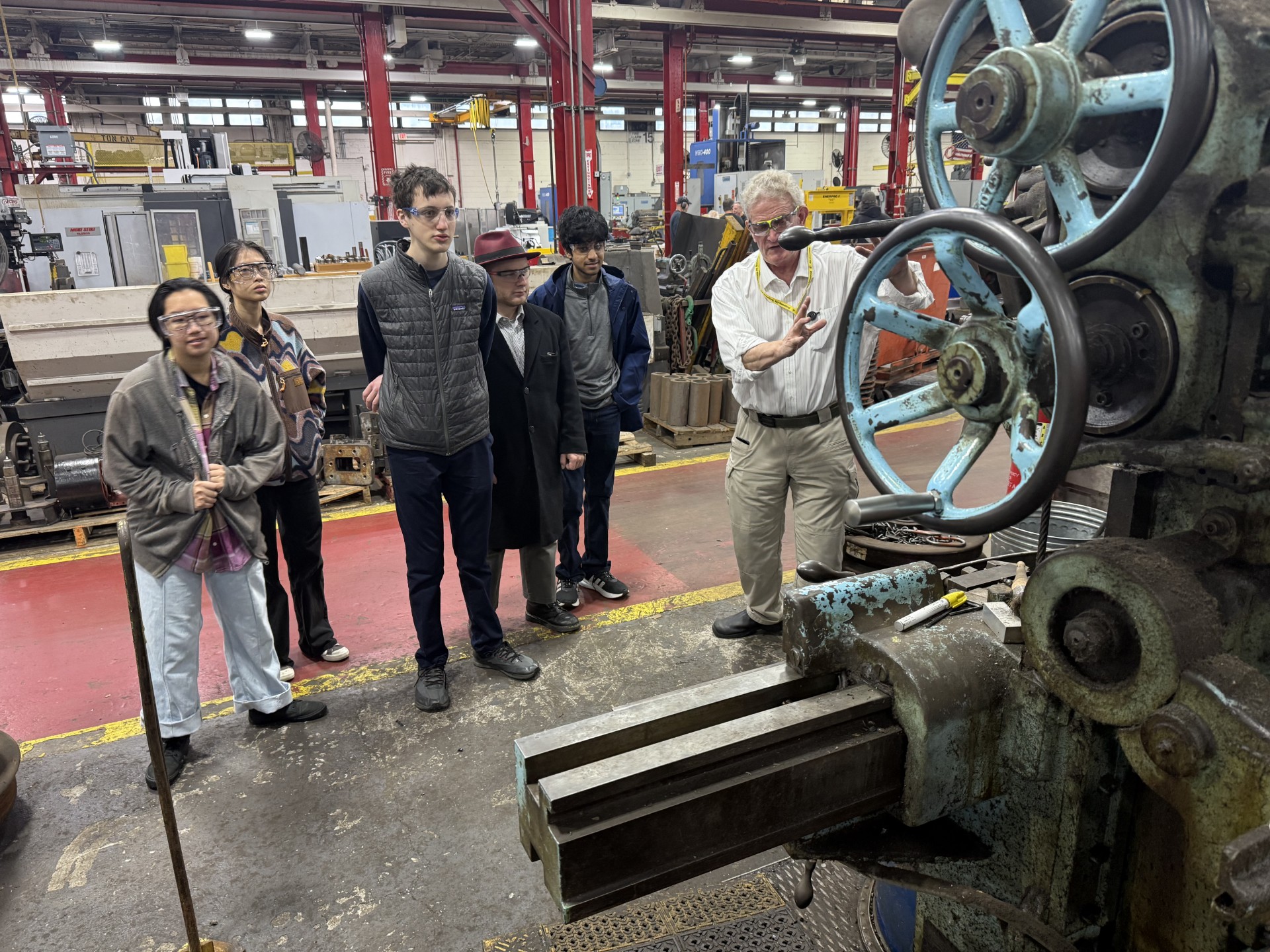
At some colleges, one of the hardest things for students are waking up early. At some colleges with suburban campuses, another challenge is getting off campus. But over the last semester, a group of Olin students were able to do both every Thursday morning for the whole semester as part of a Co-Curricular we called How-It’s-Made IRL.
A huge part of the Olin curriculum is hands-on, and we take pride in the fact that much of our curriculum is dealing with “real world” scenarios and problem solving. The shop and labs are crucial aspects of our curriculum ethos and reputation. In addition to the academic curriculum, research, project teams, and formal training in the shops, Olin also offers a number of other ways to pursue interests. Passionate pursuits and independent studies are some of those ways, but perhaps the most interesting is the Co-Curricular system. Co-Curriculars are scheduled activities hosted by faculty or staff in a subject they are passionate about themselves. Some examples include Ben Linder’s bee keeping and mushroom growing groups, Dyllan Nguyen’s print making and utensil carving, Corina Kramer’s cheese tasting, or Joanne Pratt’s bird watching group just to name a few.
Starting last semester, I began a Co-Curricular called How-It’s-Made IRL in which we visit a factory every Thursday morning to learn how things get made in manufacturing settings. This co-curricular was inspired by my own favorite class in college, in which we also went on field trips to see where various things were made. I credit that class as one of the best I took at Philadelphia University. There is an is rhetoric in political and economic circles suggesting that domestic manufacturing is on it’s way out or has already left the US shores. While there may be concern about that on some level, our tours suggests that manufacturing of all scales still happens even within a 90 minute radius of Olin.
Over the course of the semester, we visited facilities making everything from parts for a fusion reactor, to donuts and a huge variety of products in between. Students got to see up close how each of these operations run and ask questions of the industry professionals who keep it all up and running. Some students have even landed internships at the companies we visited. The complete list of companies we visited is Novolex / Waddington North America, Multiscale Systems, The Boston Globe, Starrett Tools, The MBTA, Commonwealth Fusion Systems, Dunkin Donuts, United Tool, and Emuge Franken.
So, next time you are sitting on the train, eating a donut off a plastic plate and reading an article about fusion energy in the Boston Globe on your way to cut high tech parts on a CNC mill using a carbide end mill and checking your work with a micrometer and wonder how all that came together, just ask an Olin student
For a more in-depth description of each tour, check out this article on our main site.