STORY: From Project to Publication: Oliners Put People at the Center of AI
An Olin student research team's collaboration with older adults has resulted in the ACROSS Center's first 100% Olin-based research paper, accepted to the 28th International ACM SIGACCESS Conference on Computers and Accessibility.
What happens when an Olin project becomes a research paper? For a team of Oliners working through the ACROSS Center (AI and Computing Research on Opportunities and Situated Systems, formerly the Pl(ai) Lab), it meant starting not with a technology, but with people.
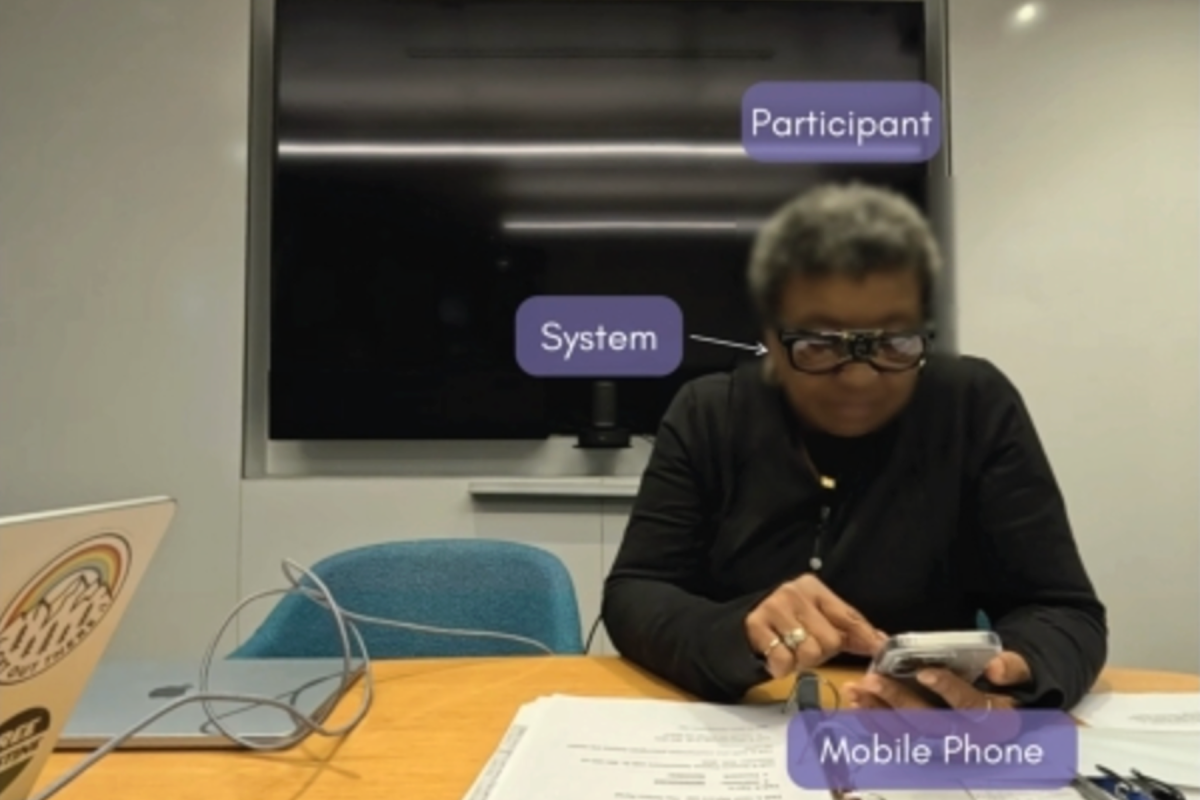
A participant in the ACROSS Center's multimodal AI assistant project completes tasks for an in-person feasibility study.
The project began with a question: How might emerging AI and wearable technologies help older adults navigate increasingly complex digital systems? Rather than designing a solution in isolation, the students spent time listening—conducting technology-support interviews with older adults and holding weekly help sessions at a local senior center. Those conversations surfaced needs that shaped the project from the ground up: preserving users' autonomy, reducing the effort required to ask for help, supporting learning rather than simply solving problems, and providing patient assistance when technology becomes confusing or frustrating.
"It was incredibly eye-opening on dissolving assumptions and being able to dive deeper into nuances that wouldn't have appeared instantaneously," says Ashley Yang ‘27. "Sustaining conversations and the same focus over months with community relationships like The Center at the Heights both opened up more questions and also a more genuine connection."
That process became an ambitious wearable system: a multimodal AI assistant combining smart glasses, voice guidance, visual overlays, and contextual information from a user's phone, designed to help older adults navigate a mock mobile patient portal—finding applications, signing in, scheduling appointments, requesting prescription refills, and communicating with a doctor.
When the team discovered that the available smart glasses couldn't yet provide the close-range visual overlays they envisioned, they adapted, building a Wizard-of-Oz system so a researcher could provide visual annotations remotely while participants interacted with the glasses and AI assistant.
"I was shocked at how wrong our assumptions were," says Kenneth Xiong ‘27. "There was no way we could have predicted how our older adult participants were going to interact with the technology. Once we got into the user sessions, it became clear—but before that, no way."
I was shocked at how wrong our assumptions were.
There was no way we could have predicted how our older adult participants were going to interact with the technology. Once we got into the user sessions, it became clear—but before that, no way."
Kenneth Xiong
Class of 2027
Working under an IRB-approved research protocol, the team conducted an in-person feasibility study with 10 community-dwelling older adults, who completed six patient-portal tasks using the system, followed by interviews and questionnaires measuring workload and usability.
Participants completed 88% of tasks overall, but their paths to completion varied considerably. Voice guidance could be helpful when accurate and well-timed, but could also become disruptive. Visual overlays proved particularly useful when spoken guidance failed, functioning as a recovery mechanism rather than simply an additional interface. The team found that designing an effective AI assistant wasn't just about task completion—it was about helping people understand what the system could and couldn't do, maintaining their autonomy, and rebuilding trust when the technology failed.
For the students, the project was an introduction to a side of engineering that's difficult to learn from a textbook. "I enjoyed writing a literature review as a first-year student," says Jack Goode ‘29. "The language in this field wasn't overly technical, so it was an approachable way to learn more about the research process. I also enjoyed interviewing the older adults, and I was surprised by the variety of perspectives on AI from our participants."
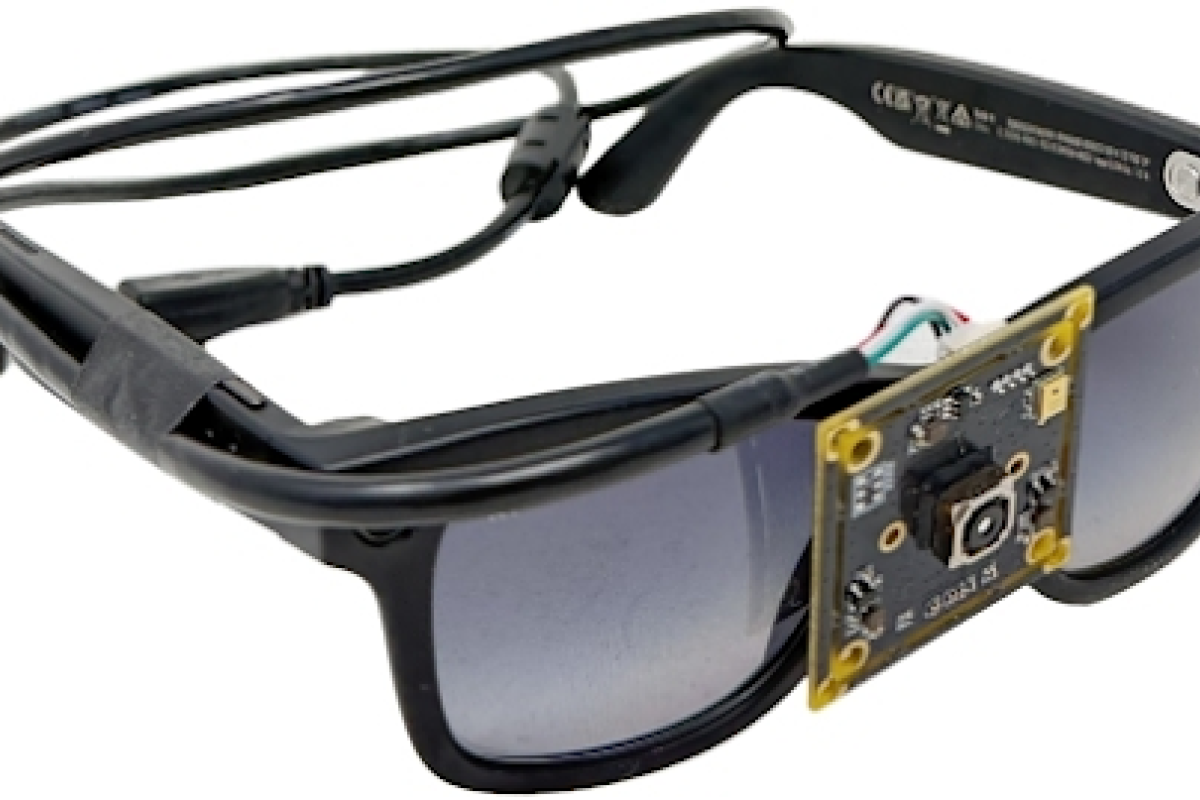
A pair of Multimodal AI assistant smart glasses designed by the ACROSS Center team.
The experience culminated in a milestone for the ACROSS Center and for Olin student research: the team's paper, "Should I use this or my mind?": Designing a Wearable Multimodal Tech Assistant for Older Adults Navigating Patient Portals, was accepted for publication at the 28th International ACM SIGACCESS Conference on Computers and Accessibility (ASSETS '26)—the first research publication authored entirely by members of the Olin community through the ACROSS Center. The conference received 338 submissions, with 102 conditionally accepted, a 30.18% acceptance rate.
"It was almost unbelievable," says Ashley Yang ‘27. "It was of course validating of our work, and also incredible to think about where we started from more than a year ago—just talking about the idea of a paper and open-ended design questions—to a concrete paper acceptance." "I was surprised by the wide range of participants' experiences, and it made me wonder why more studies don't cover this topic," says Tchenzie Guichette ‘28.
"It was almost unbelievable," says Ashley Yang ‘27. "It was of course validating of our work, and also incredible to think about where we started from more than a year ago—just talking about the idea of a paper and open-ended design questions—to a concrete paper acceptance."
The paper's acceptance is a milestone, but the project's significance goes beyond the publication itself. The researchers argue that wearable AI assistants should be designed to support—not replace—people's ability to make decisions and navigate technology themselves. Their findings point toward systems that adapt their pacing and level of assistance to individual users, coordinate different forms of guidance, and deliberately build rapport and trust.
"My nursing background helped the team account for real-world patient needs, like tremors, vision changes, and the challenges of using a patient portal," says Cynthia Orofo, one of the study's lead authors and postdoctoral fellow at the ACROSS Center. "The glasses, interface, and study design benefited from an interdisciplinary approach rather than engineering alone—together, we kept participants' experiences at the center. Looking forward to the application of this work in expanded practical settings."
"It's such an honor to work with Oliners, because the skills they learn through our engineering curriculum center people," says Andrea Cuadra ‘13, one of the ACROSS Center's three faculty leads. "Research in our group provides them the opportunity to deepen those skills, and gain validation in the academic community at a global level."
Paul Ruvolo, another ACROSS Center faculty lead, was impressed with the student team's ability to take a lead role in the research. "They displayed great resourcefulness and initiative during the course of the project. I don't think undergraduates at many other schools would have the skills needed to carry out this ambitious open ended research work", says Ruvolo.
The team will present the work at ASSETS '26 in Vila Nova de Gaia, Portugal, October 25–28—another step in a journey that began much closer to home: sitting with people, listening to their frustrations and strategies, building something together, and learning how to turn those experiences into knowledge that others can build on.