NEWS: From Healthcare to AI: Four Olin Teams Win Prizes at MakeMIT x Harvard Hackathon
Four teams featuring Olin College of Engineering students won prizes for their hardware projects - spanning topics from healthcare to AI - at February’s MakeMIT x Harvard Hackathon.
MakeMIT x Harvard, a collaboration between MakeMIT and MakeHarvard, is one of the largest hardware hackathons in the world, bringing together more than 400 competitors. Over 24 hours, teams of up to six people design and build working hardware prototypes to compete for $10,000 in prizes.
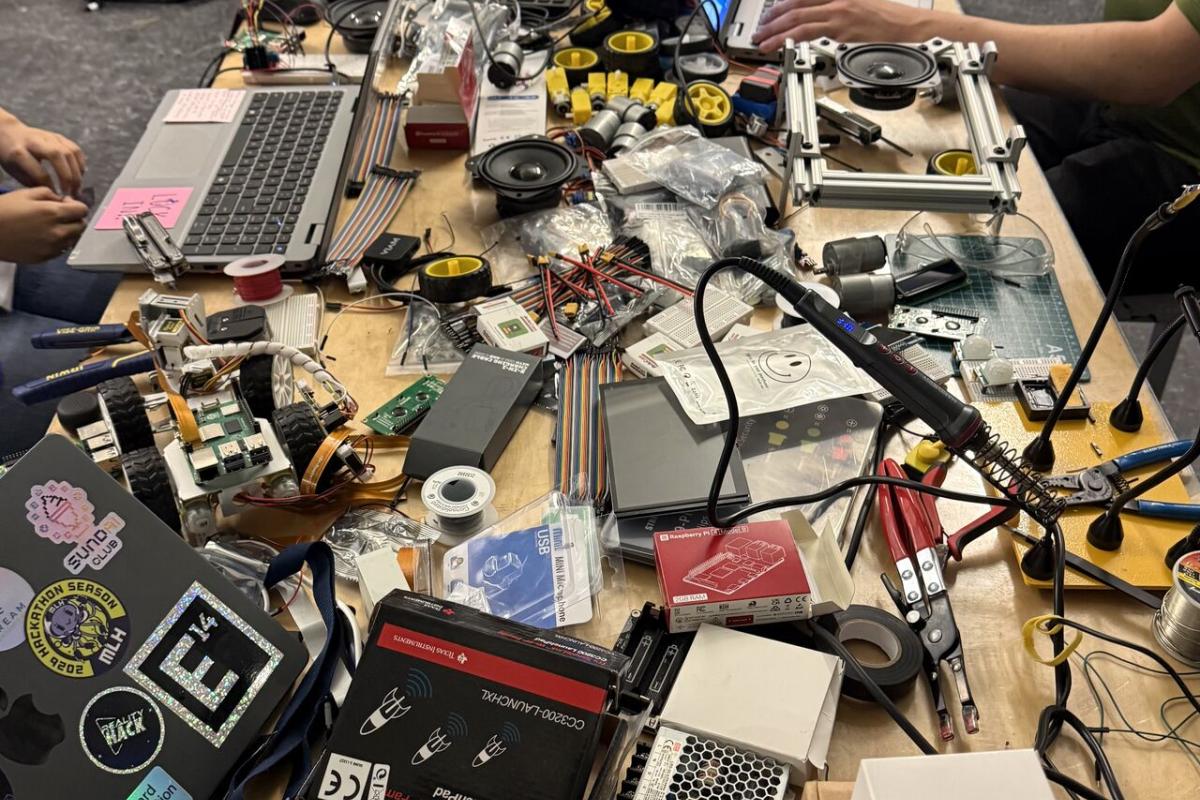
Photo by Maria Gorskikh (MIT Visiting Lecturer) showing their team's workspace at the MakeMIT x Harvard Hackathon. The team included Maria, Mateo Brancoli '27, and Navya Tiwari '28, who built a robotic swarm called Triad.
Participants were provided access to laser cutters, 3D printers, soldering stations, microcontrollers, materials, and mentorship - encouraged to “bring only their ideas and curiosity.”
From there, the Oliners and other hackers chose from five Infosys challenge tracks to build and compete in: Healthcare, Sustainability, Communication, Entertainment, or AI Doorman - a system designed to take action rather than simply record. Depending on the project, teams could also apply for the Seeed Studio Interactive Signage Track and compete for the overall grand prize. Each team was also tasked with filming a demo video to submit alongside their projects for judging.
When the 24-hour build came to a close, judges reviewed the submissions and selected the standout projects across the various tracks.
Four teams featuring Olin students ultimately emerged with prize-winning builds.
See the teams and their projects below.
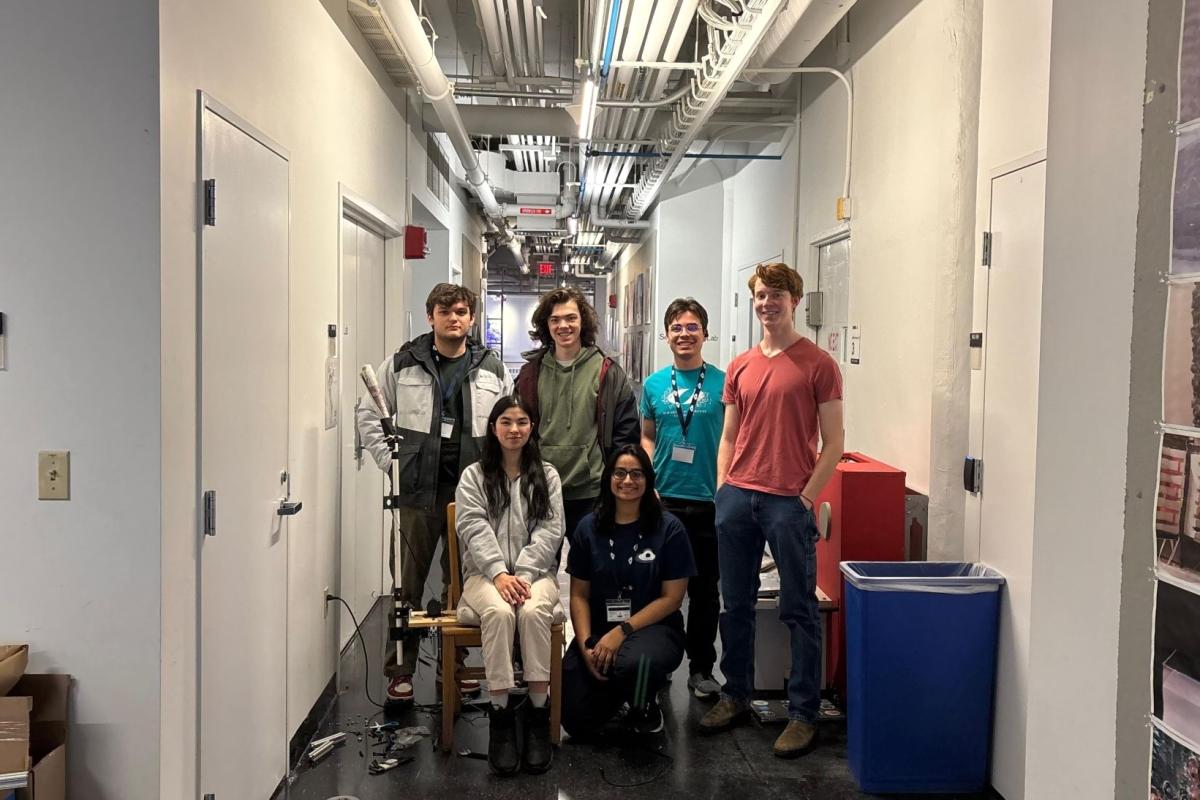
The Olin team of (Front row) Maya Adelman '27, Antara Mazumdar '28, (Backrow) Brandon Spiller '28, Liam Fries '28, Jeffrey Woodyard '27, and James Hamilton '28, won the top prize in the ElevenLabs Tool track for their project, Wackathon.
Project: Whackathon
Tool Track: ElevenLabs
Prize: Best use of ElevenLabs
The team of Brandon Spiller ’28, Maya Adelman ’27, Jeffrey Woodyard ’27, James Hamilton ’28, Antara Mazumdar ’28, and Liam Fries ’28 earned the top prize in the Tool track for their project, Whackathon.
Whackathon is a posture-correcting device that uses negative reinforcement to make users more aware of their slouching - delivered with a dose of humor! Built around a standard chair, the team installed an array of ultrasonic distance sensors that feed data into a microcontroller, which calculates when a user’s posture shifts into a slouch.
When slouching is detected, the system waits briefly before triggering a tension-loaded mechanical mechanism that taps the user with a rolled-up newspaper. At the same time, a custom Python desktop application on the host laptop verbally roasts the user using the ElevenLabs AI Voice Generator.
Watch the team's posture-correcting device as it encourages proper form!
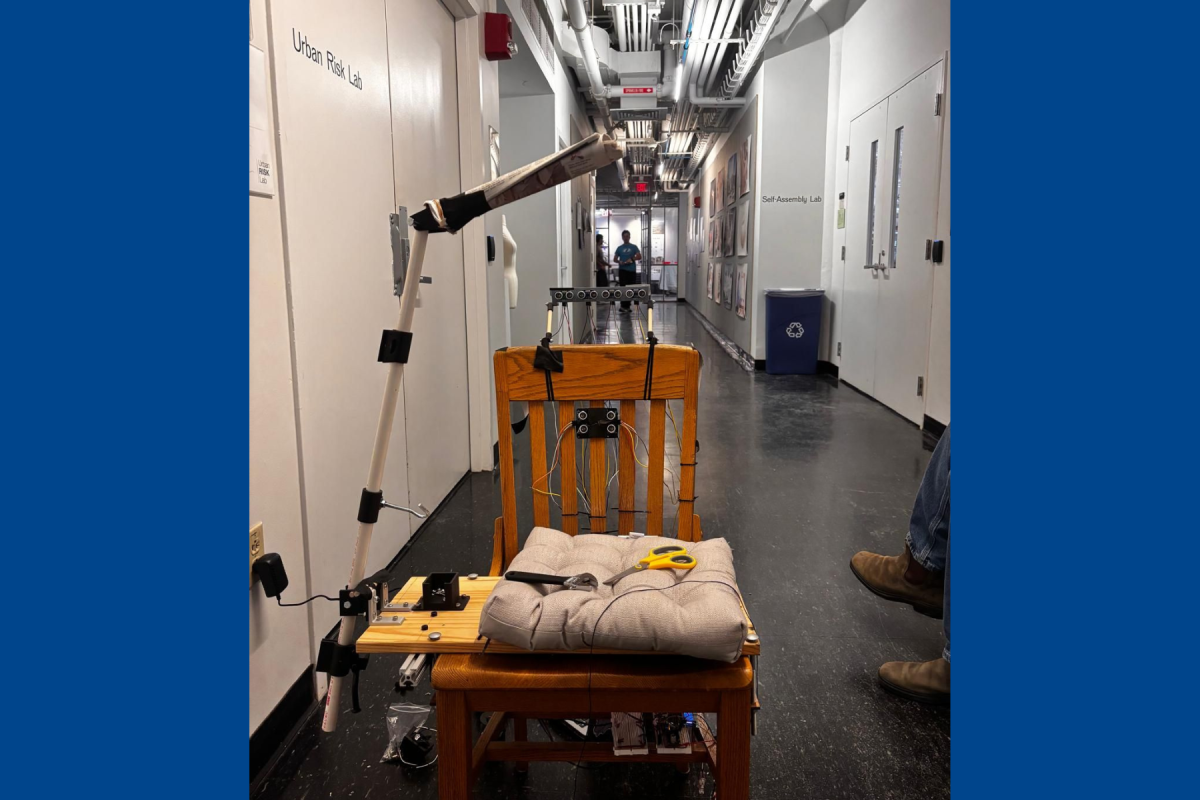
Watch: The Whackathon is a posture correcting device that utilizes negative reinforcement to make people more aware of their posture habits in an entertaining way.
“This project was very fun to work on, and I had such a great time thanks to the amazing people who ran the event, the cool teams that participated, and the extraordinary team I got to work with,” said Spiller.
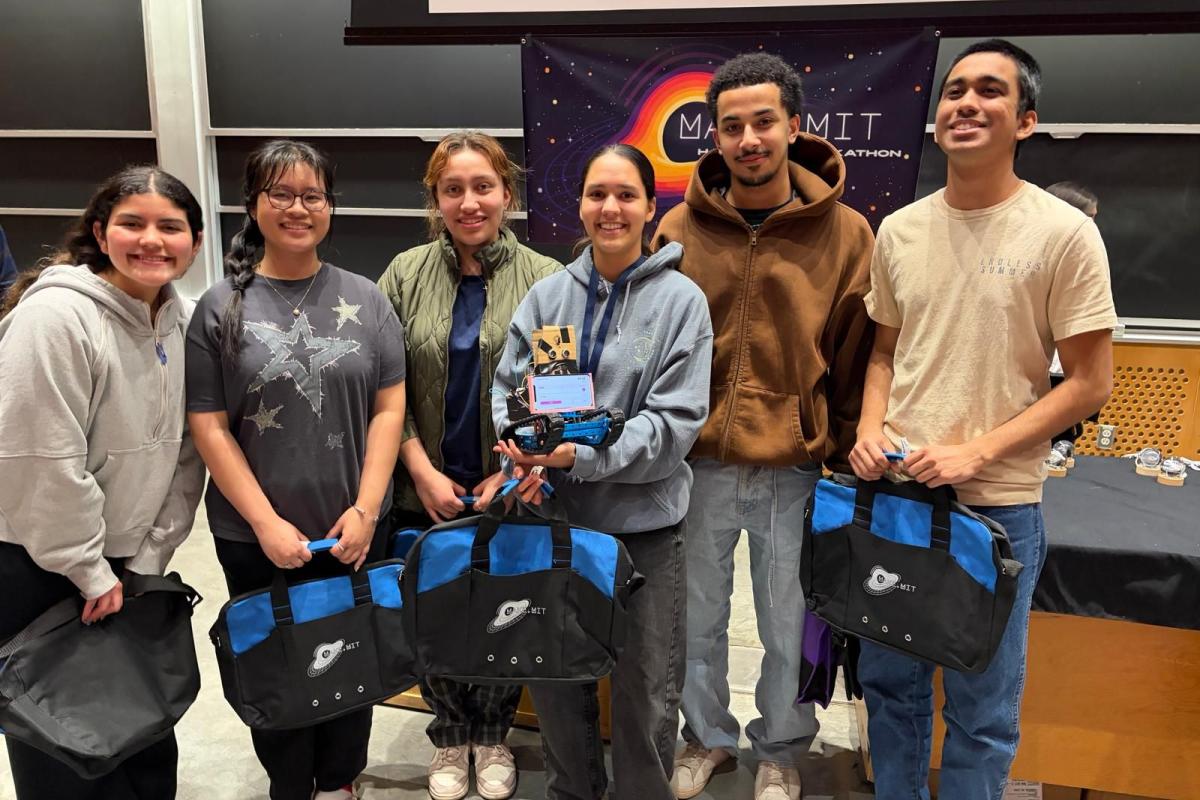
The McLockin Jr. team pose with their MakeMIT x Harvard hackathon project, an all-in-one productivity and wellness assistant designed to keep you focused while protecting your health.
Project: McLockin Jr.
Track: Healthcare
Prize: 2nd Place
For their hardware project that took home 2nd place in the Healthcare track, Pia Swarup '29, Jenny Vo '29, Sofia Ramos '29, Anfal Hosen '29 (MIT), Yusef Primus '29 (MIT), and Mellanie Rodriguez '29 (MIT), built a smart desk companion designed to improve focus, posture, and healthy work habits.
The team wanted to tackle multiple problems that they themselves face daily as students: eye strain, poor posture, and distraction.
"Our desk companion, McLockin Jr., is an all-in-one productivity and wellness assistant designed to keep you focused while protecting your health," says Swarup.
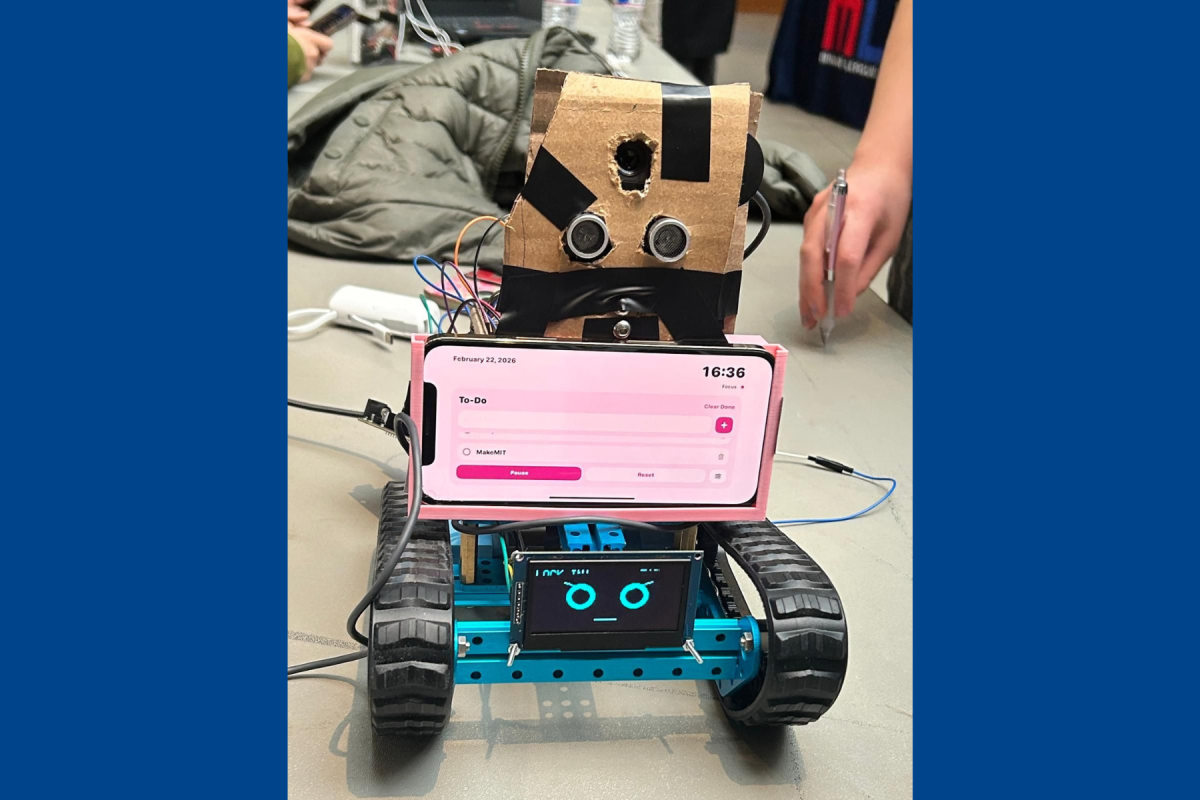
The McLockin Jr. is a smart desk companion designed to improve focus, posture, and healthy work habits.
Here’s what the McLockin Jr. team built in just 24 hours:
-
Focus Activation: Insert your phone into the companion (with wireless charging) and it automatically launches a Pomodoro timer + TODO list to start a deep work session.
-
Anti-Distraction Mechanism: An integrated ultrasonic sensor detects when you try to grab your phone. The companion rolls back twice before letting you take it, aiming to reduce impulse notification checking.
-
AI-Powered Focus Tracking: The companion connects to your computer and uses a YOLO-based vision model (with one-time calibration) to track attention. If you’re unfocused for 10+ seconds, it outputs a voice reminder powered by ElevenLabs text-to-speech.
-
Eye Protection: If you stare at your screen for 20+ minutes straight, it reminds you to take a break.
-
Posture Monitoring: Using a YOLO Pose model and a camera on the companion, it detects poor posture and prompts corrections in real time.
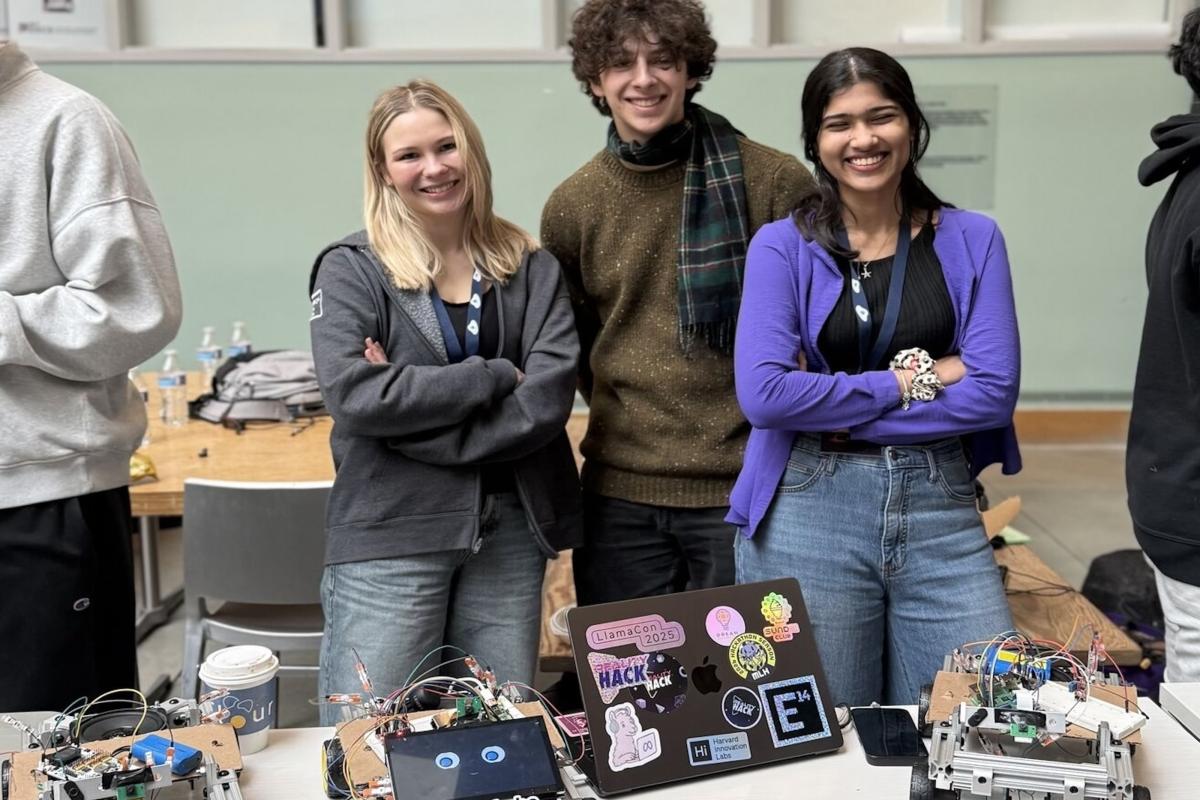
(L to R): Maria Gorskikh (MIT Visiting Lecturer), Mateo Brancoli '27, and Navya Tiwari '28, built a robotic swarm at the hackathon called Triad.
Project: Triad
Track: Seeed Studio Interactive Signage Track
Prize: 3rd Place
Maria Gorskikh (MIT Visiting Lecturer), Mateo Brancoli '27, and Navya Tiwari '28, spent their time building a robotic swarm they call Triad.
The team says the core idea of their third place-winning build in the Seeed Studio Interactive Signage track was simple and a little unhinged (in a good way.) They asked what happens if you give an AI agent a physical body, and then give multiple agents bodies and let them coordinate.
Instead of building a single autonomous robot, they gave multiple AI agents physical bodies and let them synchronize.
Each robot ran OpenClaw agents on Raspberry Pi 5 and Pi 4 boards, connected to wheels, cameras, microphones, and speakers. The bots could see their environment, reason about it using Gemini, move, speak using ElevenLabs, and communicate with each other to plan actions in real time.
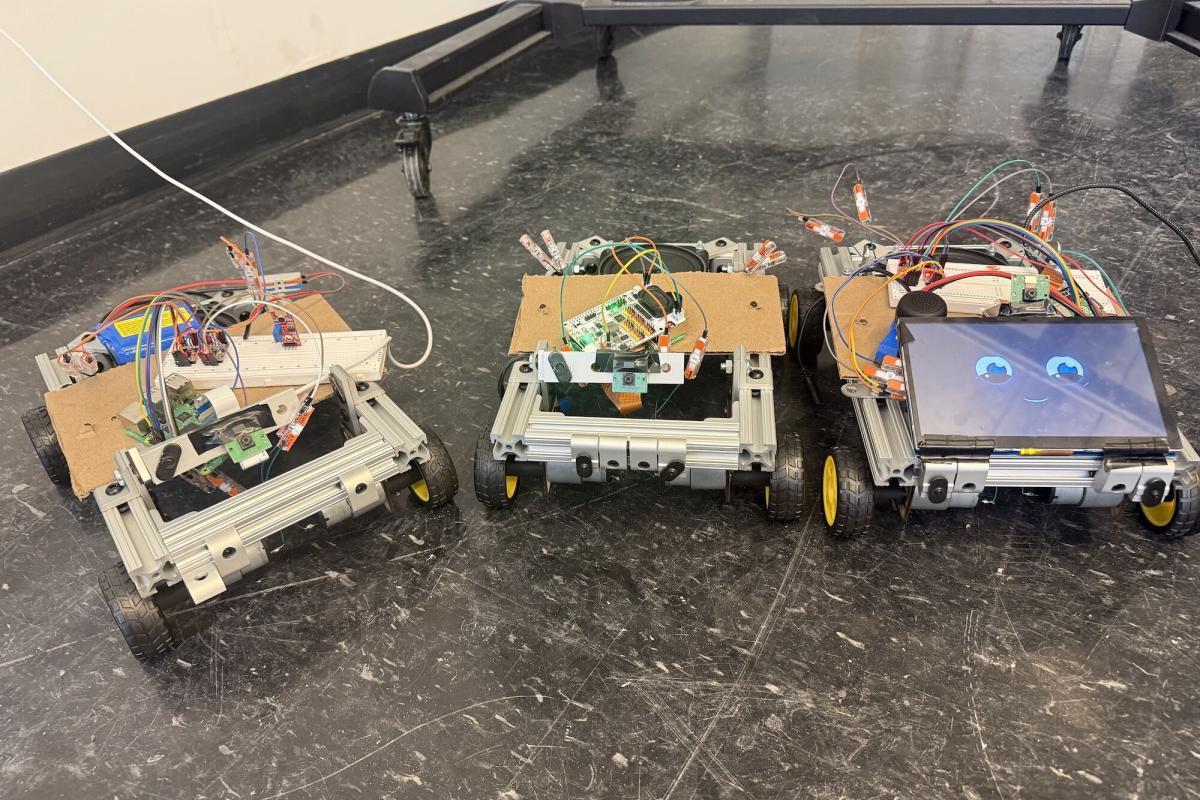
Project Triad, the small swarm of robots built by Maria Gorskikh (MIT Visiting Lecturer), Mateo Brancoli '27, and Navya Tiwari '28, at MakeMIT x Harvard.
Photo by Maria Gorskikh.
"The interesting part was not just one robot acting autonomously, but multiple robots communicating with each other in natural language, sharing observations, planning, and coordinating actions. At that point, you start to see the limits of today’s approach. Natural language works, but it is not really a protocol," says Gorskikh.
Read more from Maria about the project idea.
The coordination evidenced by the robot swarm also stood out to Tiwari.
"Once robots start talking to each other, you quickly see that natural language isn’t really a protocol. There’s so much room to rethink agent-to-agent communication and how we define physical capabilities as tools that LLMs can meaningfully control," she says.
"One robot is useful. A swarm of embodied AI agents feels like an entirely different category."
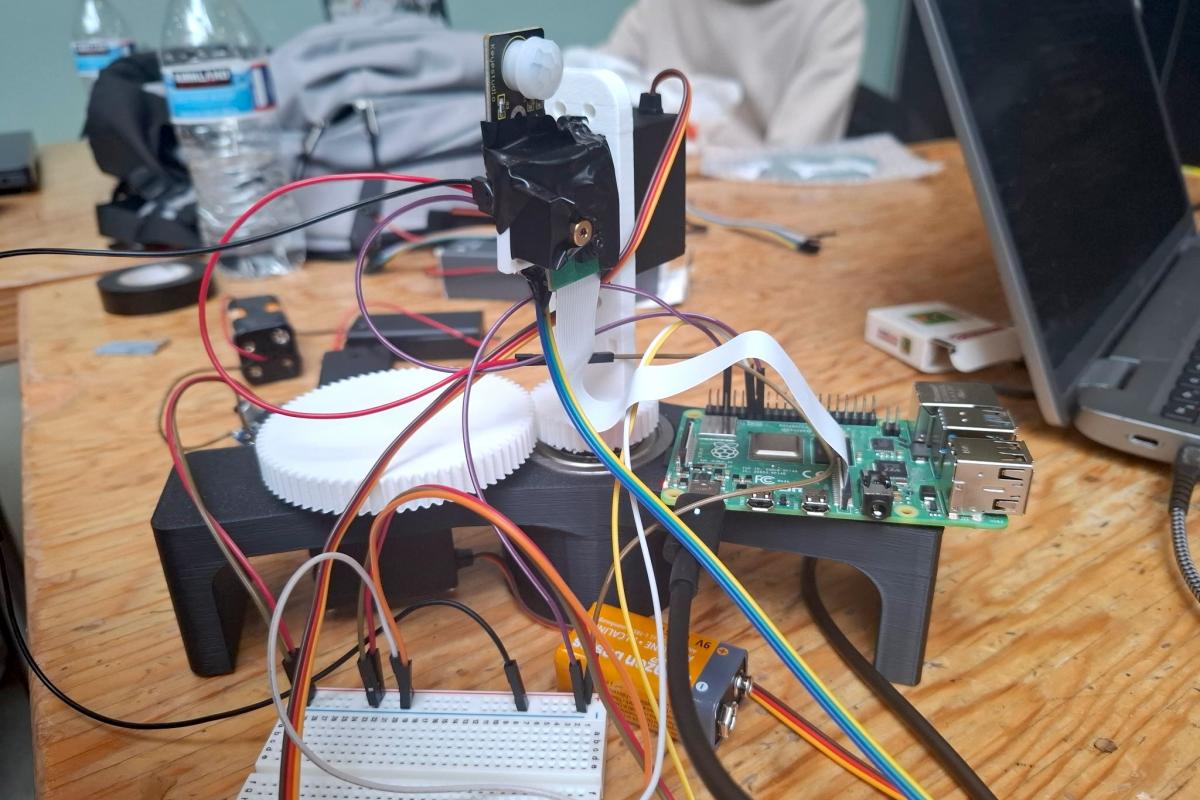
The MakeMIT x Harvard team of Grant Rechtin '28, Jason Spitzak '29, Sabal Poudel '29 (Virginia Tech), Vitek Němec (Columbia University), and Benjamin Runde '28 (Northwestern University), developed a computer-vision–powered laser turret concept, AuraShield, designed to deter and prevent privacy intrusions (such as unauthorized cameras) without causing permanent harm to people or devices.
Photo by Benjamin Runde.
Project: AuraShield
Track: Home Security
Prize: 3rd Place
Grant Rechtin '28, Jason Spitzak '29, Sabal Poudel '29 (Virginia Tech), Vitek Němec (Columbia University), and Benjamin Runde '28 (Northwestern University), developed a computer-vision–powered laser turret concept, AuraShield, designed to deter and prevent privacy intrusions (such as unauthorized cameras) without causing permanent harm to people or devices.
It all started from an idea some of the students had thinking about a creative way to deal with mosquitoes in the summertime. And it ended with the team constructing a new approach to their theory, winning a third place finish in the Home Security track.
"At the hackathon, we reframed [the idea] into a safety-first home security application aligned with the competition track - and turned it into a working concept," says Sabal.
Watch the team's computer-vision-powered laser turret in action.
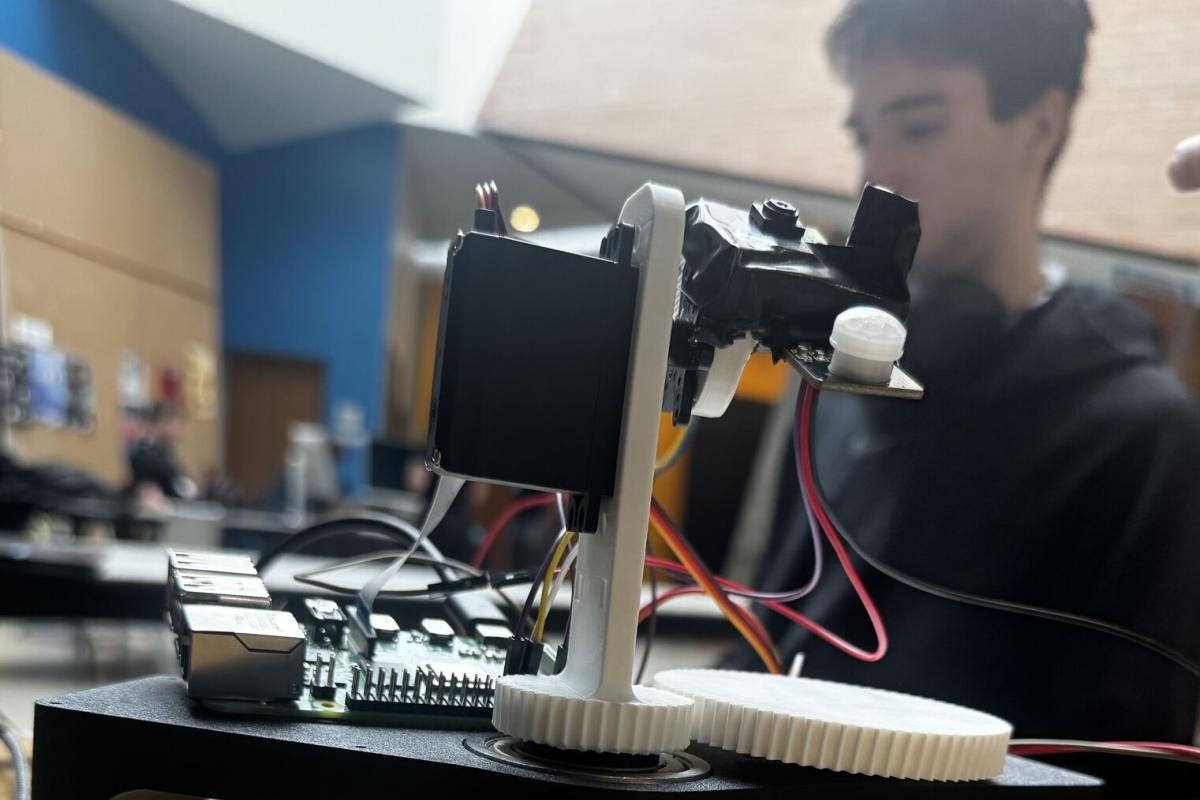
Watch: AuruShield is a computer-vision–powered laser turret concept designed to deter and prevent privacy intrusions (such as unauthorized cameras) without causing permanent harm to people or devices.
Photo by Benjamin Runde.
For the Olin students involved, the experience reflected the fast-paced creativity that defines hardware hackathons - bringing together engineering, experimentation, and collaboration in a single 24-hour sprint. From playful builds to practical prototypes, the projects showcased how quickly ideas can take shape when curiosity, teamwork, and a table full of tools come together.
Check out: Three Olin teams took home top prizes in MakeHarvard2020's hackathon.