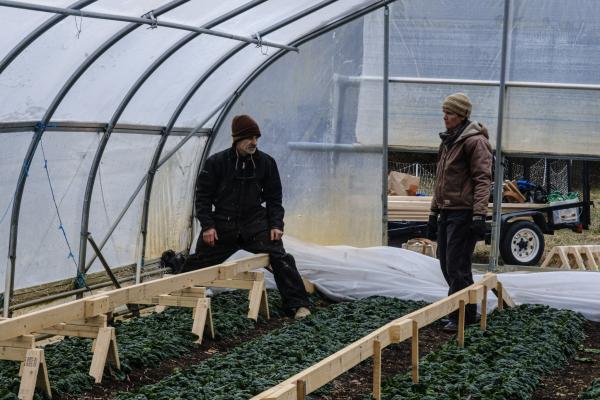
STORY: Students Develop Automated Fruit Sorting System for Local Berry Farm
Last year, students in Olin’s “Robotics Systems Integration” course gained real-world experience developing an efficient, low-cost solution to help a local blueberry farm better sort their harvest.
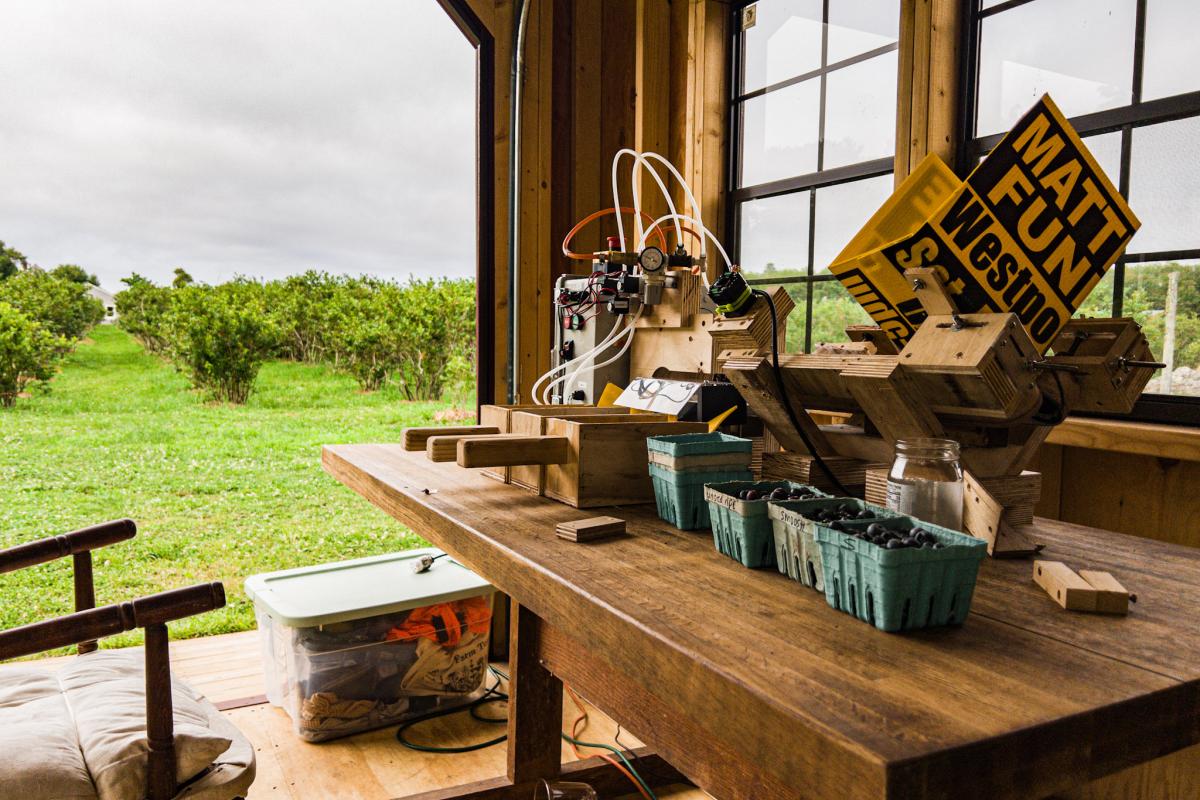
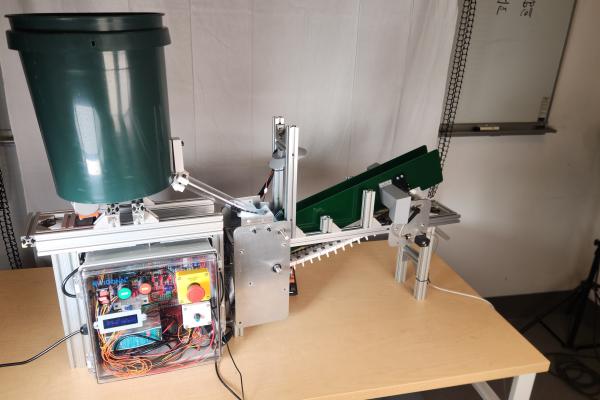
The automated fruit sorting system at Berry Hill Farm in Upton, Massachusetts. It was engineered by students in Kenechukwu Mbanisi's "Robotics Systems Integration" course in collaboration with Lu Yoder and James Davis ’24.
Photo by James Davis ’24
Because of the small size and delicacy of blueberries, Berry Hill Farm in Upton, Massachusetts, was sorting harvested fruit by hand, separating out unripe and overripe berries before packaging. Automated sorting machines do exist, but they are far too expensive and impractical for small- to medium-sized farms to consider.
Enter Lu Yoder, a jack-of-all-trades engineer and innovative farm technician who is well-known in the region for creative solutions to farming challenges, such as bicycle-powered carrot washers and seed cleaning machines and a light electric walking tractor called the Weed Weasel.
Yoder had received a Sustainable Agriculture Research & Education (SARE) grant from the U.S. Department of Agriculture to help small farms in Massachusetts improve productivity and lower costs, and he reached out to Kenechukwu Mbanisi, assistant professor of robotics engineering, to see if Olin students might want to get involved. Mbanisi has a strong interest in the intersection of robotics and agriculture, having worked with students on soil-monitoring drones and an award-winning autonomous weeding robot in the past.
“The primary goal of ‘Robotics Systems Integration’ is to give students who have a real passion for robotics experience working with external partners in real-world contexts,” says instructor Mbanisi. “Lu’s challenge was ideal for this, especially because we had to work quickly to get ahead of the next harvest in July."

The primary goal of ‘Robotics Systems Integration’ is to give students who have a real passion for robotics experience working with external partners in real-world contexts.
Lu’s challenge was ideal for this, especially because we had to work quickly to get ahead of the next harvest in July."
Kenechukwu Mbanisi
Assistant Professor of Robotics Engineering
Students AJ Evans ’25, Alana MacKay-Kao ’26, Jacob Prisament ’25, and Luke Witten ’25 took on the project, meeting with Yoder and the farmers to understand their design requirements. The sorting system needed to be small enough to not require too much storage; modular in case the farmers needed to add more capacity; and fast enough to sort as many or more blueberries per minute than the by-hand system.
“We started with a lot of research into existing blueberry sorting machines, as well as things like marble moving competitions,” says MacKay-Kao, who obtained her BA in Physics from Wellesley College last year and is now earning her engineering degree with a concentration in robotics (E:ROBO) as part of Olin’s 4+1 program. “We debated about using AI for the classification system, but we ended up going with a lower-tech option based on berry color due to time constraints.”
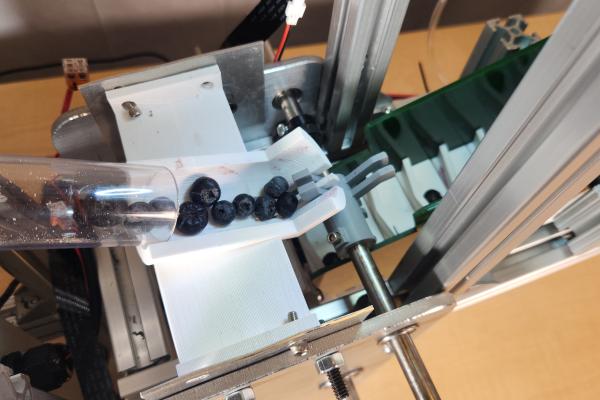
By the end of the semester, the students had built a functional prototype with a loading component that could gently handle the fragile fruit, a color-based classification system that recognizes and labels each berry’s ripeness, and a sorting component that uses a pneumatic burst of air to flick overripe berries off the conveyor belt.
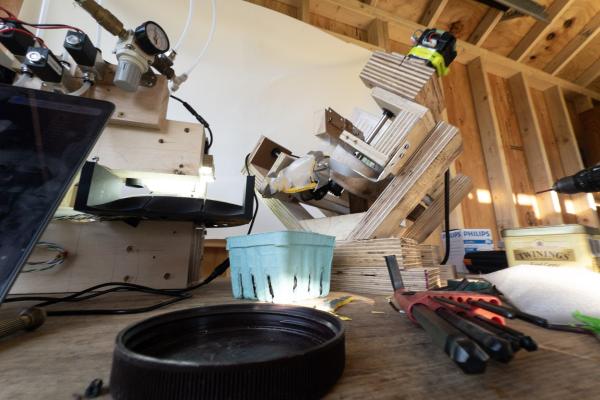
“The variety of machines that Olin has available to students, especially at The Olin Shop, was a huge help in iterating a bunch of different tests quickly,” says MacKay-Kao. “We used sewing machines for little fabric belts and Legos for mockups of sturdier ones. Our initial prototype was laser-cut pieces of wood, but what we handed off at the end of the semester to Lu was water jet-cut metal, so it was a lot closer to a real working machine.”
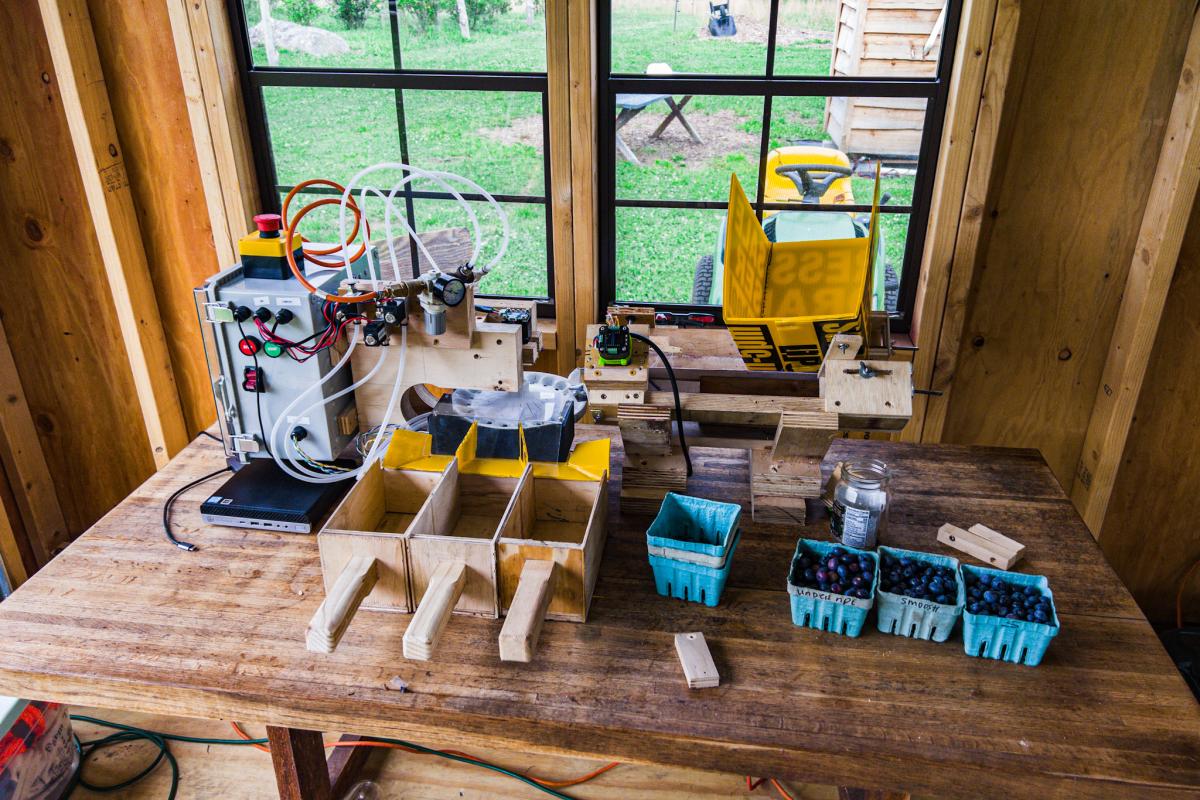
After the students gave their 1.0 version of the blueberry sorting system to Yoder, he began working with another collaborator: alum James Davis ’24, who also has a passion for engineering and agriculture. An Olin alum through and through, Davis enjoys finding a middle ground between innovation and economic accessibility.
“Sometimes you don’t need to build the fanciest, highest tech thing, and the students came up with a really cool design that Lu and I can now continue to build on,” says Davis, who researched expired patents for industrial scale machines to further improve the system. “Being at Olin instilled in me the idea that engineering isn’t just about building technical knowledge, but also how you then share that learning with the world.”
“A big part of learning objectives at Olin is getting students to make the connection between high-tech engineering capabilities and value-driven impact, especially in a local context,” says Mbanisi. “These kinds of human-centered or user-oriented design projects let students work on things they find cool or exciting while also developing ways of thinking about the role of engineering in the world that ground them.”
At the end of the recent harvest season, Berry Hill Farm hosted a festival for the local community, and Yoder and Davis got to demo the 2.0 sorter for the crowd, including other farmers. Among other updates, Yoder and Davis have swapped out the fish-toothed conveyor belt for a one-piece carousel, and they’re working on training a neural network-based inference model for classification to improve the yield rate. They also want to reduce the part count so the final product can be something that someone with minimal mechanical experience can assemble.
Yoder and Davis continue to collect feedback from farmers on how they could improve the design with an eye toward the potential for commercial production one day.
Photos and videos were taken and provided by Alana MacKay-Kao ’26, Jacob Prisament ’25, and James Davis ’24.
More Photos
Last year, students in Olin’s “Robotics Systems Integration” course gained real-world experience developing an efficient, low-cost solution to help a local blueberry farm better sort their harvest.