Olin Students Learn to Take Action in New “Local Democracy” Course
While Olin students spend plenty of time solving technical problems, a new course asks them to tackle a different kind of challenge: how to participate in democracy where they live.
“Local Democracy,” a new Arts, Humanities, and Social Sciences elective taught by Erhardt Graeff, associate professor of social and computer science, moves civic engagement out of the abstract and into the real world. The curriculum introduces students to the mechanics of municipal politics, while also encouraging them to think about their own responsibilities as citizens and future engineers.
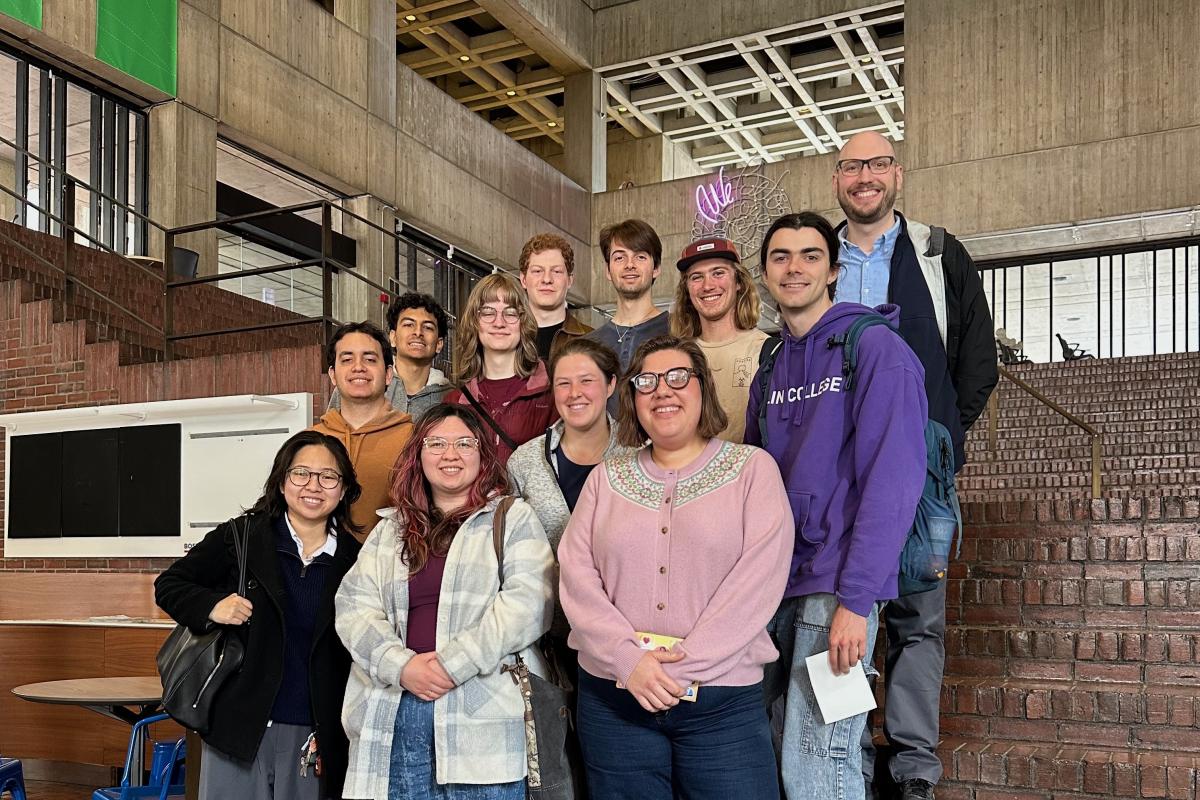
Professor Graeff's Local Democracy class stand on the steps outside Boston City Hall.
The course grew out of Graeff’s long-running class “Democracy and Media,” but took shape through his own experiences serving in local government in Needham. Graeff has served both as a trustee of the Needham Free Public Library and as a Town Meeting member representing his precinct.
“When people have conversations about politics in everyday life, it’s often on a national or international scale, but the biggest opportunity you have to make change is really at the local level,” says Graeff. “With this course, I want students to see the impact they can make and give them the tools to do so.”
"With this course, I want students to see the impact they can make and give them the tools to do so” says Erhardt Graeff, professor of Local Democracy.
“Local Democracy” examines how communities make decisions about issues students encounter every day, such as transportation, sustainability, public services, and education. In addition to classroom lectures, guest speakers, and readings, students are tasked with “dining from the menu of local engagement,” as Graeff calls it, which can range from subscribing to local government newsletters to attending public meetings.
“This course is intended to reveal the ‘hidden language’ of civic engagement,” says Graeff. “Who do you need to talk to? Where are the power centers in a community? That isn’t obvious information until you learn it from somebody else.”
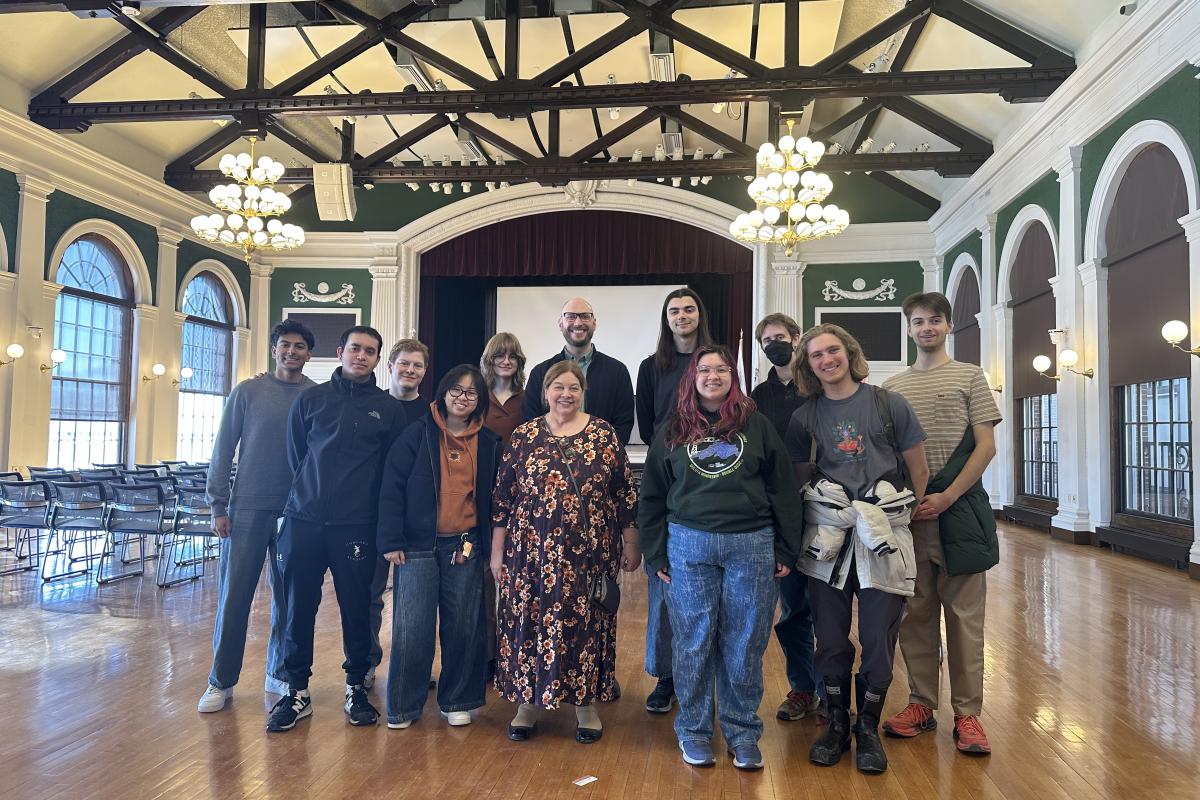
Local Democracy students pose for a group photo inside Needham Town Hall.
For many students, that practical focus is what makes the class stand out. Wilder Brown ’27, a mechanical engineering student taking the pilot course, said the subject matter appealed to them because of the growing overlap between engineering, technology, and politics.
“Technology has a super large role on the political landscape,” says Brown. “I’ve increasingly seen engineering as a tool toward political ends.”
"Technology has a super large role on the political landscape, I’ve increasingly seen engineering as a tool toward political ends” says Wilder Brown '27, a Local Democracy student.
Brown, who works part-time at a local farm in Dover, Massachusetts, used the class to explore issues surrounding local agriculture and land use. Through visits to planning board meetings and conservation commission discussions, they researched how local zoning laws affect sustainable farming and food systems.
“There are a lot of power dynamics around how people use land and what incentives there are,” says Brown. “I learned that Needham makes it pretty easy for people to use small plots of land for farming without a lot of zoning restrictions, so I have been looking into what it would take to use some of the woods behind Olin’s campus to start a small garden.”
The class relies heavily on experiential learning, a hallmark of Olin’s educational philosophy. Students took multiple field trips in and around Needham, including one to Boston City Hall, where they were hosted by Maia Materman ’22 and Emily Nasiff ’21, two Olin alumni who work in public service there.
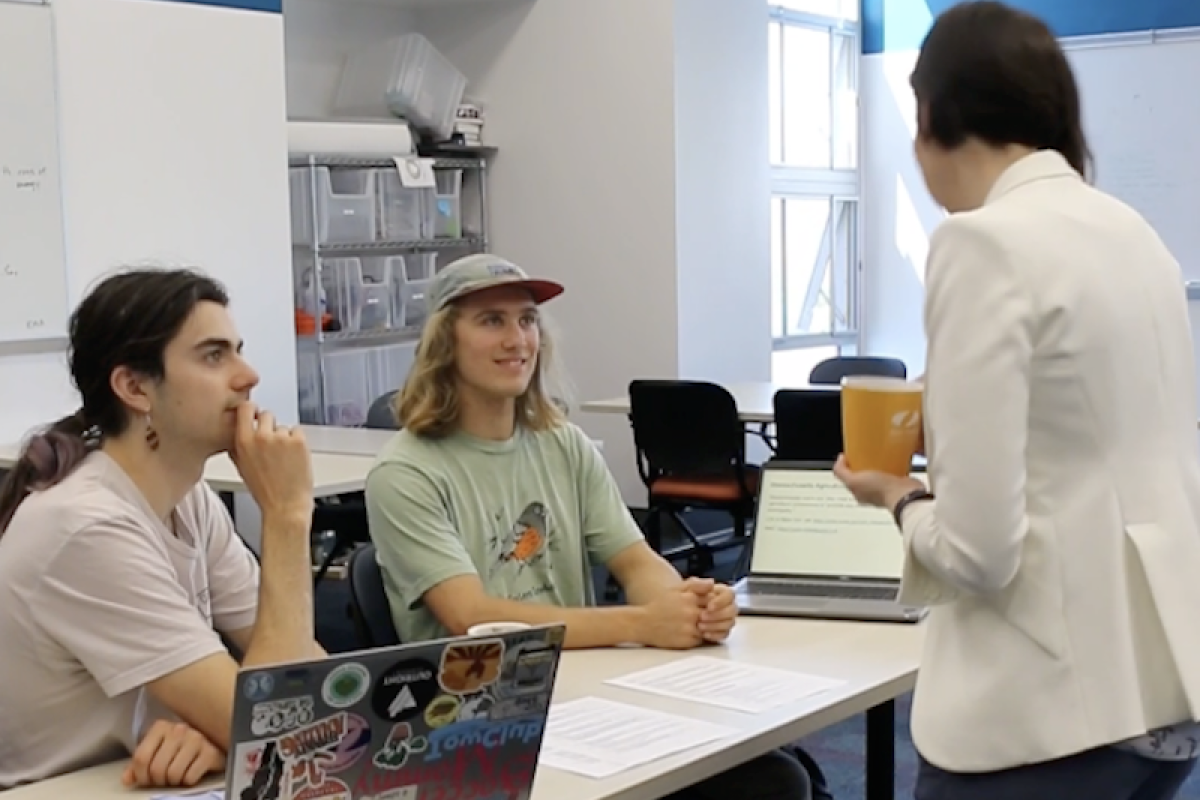
Local Democracy students present at their end of year final project showcase.
With Materman and Nasiff as guides, students toured City Hall’s buildings, meeting clerks, planners, policymakers, and more. They participated in a Q&A with a transportation planner and the director of Spark Boston, an engagement and networking program for young adults, as well as learned more about Materman’s and Nasiff’s day-to-day responsibilities and how they got into their roles.
“It was cool to see students excited about this work, which mirrored how I felt when I was at Olin,” says Materman, the senior manager of delivery in the City of Boston's Department of Innovation and Technology. “The field trip helped make the government feel tangible and accessible for the students. At some point, you’re going to live somewhere, and knowing how to get involved in that place is really important.”
Students’ final projects see them creating civic education tools that help others navigate local democracy, such as teaching a peer or parent how to write an opinion piece or walking them through the process of navigating their own local government. Projects are displayed in a showcase at the end of semester where students share what they came up with.
“Community self-governance requires us to have a shared set of knowledge and skills, so I want students to be able to create a final deliverable that is replicable for someone else,” says Graeff. “The idea is if this is a civic education course and students are thinking about their responsibilities as civic actors, then one of those responsibilities is to pay that knowledge forward.”
Final projects included a workshop on zoning and land use regulations for agricultural practices on residentially zoned properties by Brown and Peter Schnell ’26 with two Olin faculty; a guide on how to encourage volunteerism among a college organization, club, or friend group by Dakota Chang ’27; and a set of recommendations for how to write an opinion piece in Olin’s student-run publication Frankly Speaking (as well as a follow-up op-ed outlining best practices) by Elías López Dalla Nora ’27.