STORY: Team of Olin Students Builds 14-Foot, Flying, Fire-Fighting Robot
A group of Oliners put their engineering skills and passion for positive change to work by building a 14-foot, eight-armed autonomous drone called OCTAL designed to extinguish wildfires before they grow out of control.
The project, led by Ian Walsh '26, came about after a family friend’s house burned down in 2025 during the Palisades wildfire in California. The inspiration, he recalls, came quickly.
"It’s painful to see everything someone owns—their home, car, photos, all the evidence of their life—violently destroyed," says Walsh, an electrical engineering major. "Tragically, many people lose their lives, too. I wanted to find a feasible way to eliminate that risk."
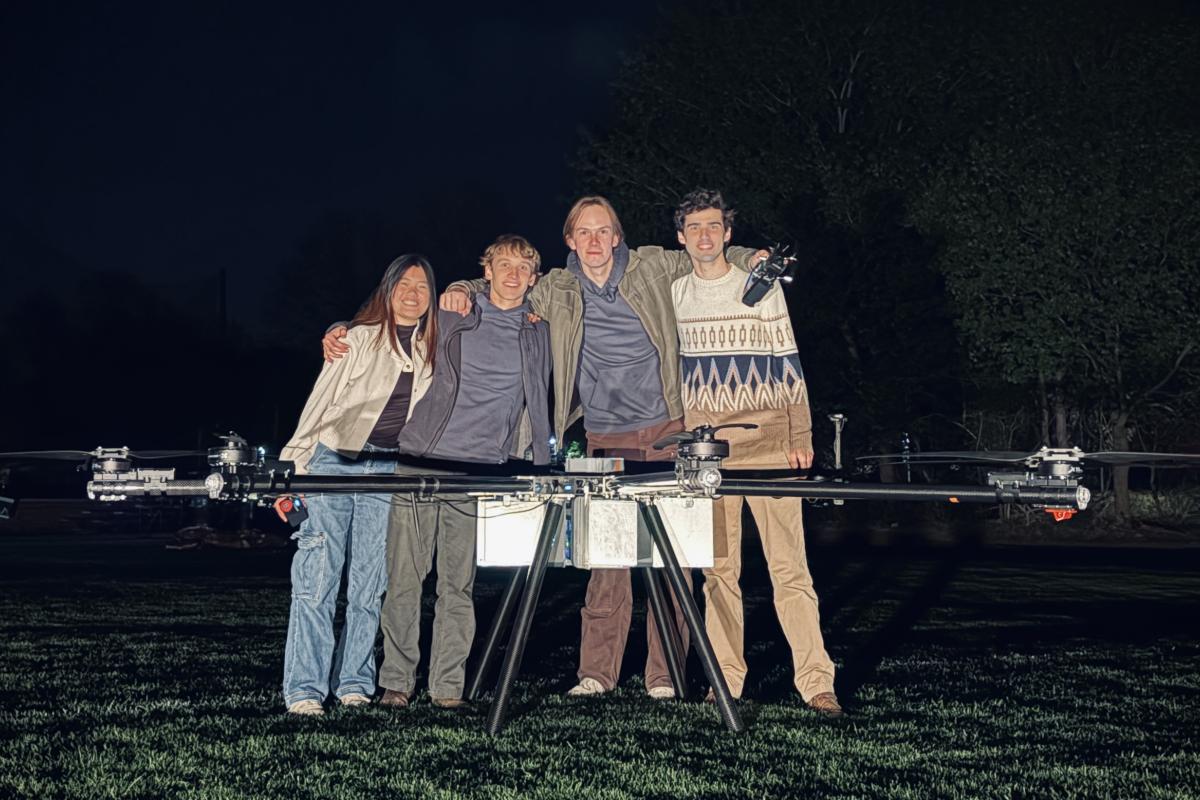
OCTAL team members pose for a group photo with their firefighting drone after a test flight.
Taking pages from the playbooks of several courses he took at Olin—a second-year class called "Collaborative Design" and the senior-year Technology Venture Capstone, Walsh started OCTAL by conducting about two dozen interviews with first responders across the West Coast to understand what would help them most.
"Firefighters frequently mentioned feeling overworked and exhausted, and that their crews couldn’t keep up with the constant barrage of new blazes, especially in hard-to-reach areas," he says. "And firefighting, already an extraordinarily dangerous job, is getting riskier every year."
National records show the number of fires in the U.S. hasn't drastically increased over the past three decades, but the total acreage burned has roughly tripled. In that same timeframe, the average Burning Index, a key metric of a wildfire's intensity, has also steadily risen by about 50 percent. Even small fires have gotten more dangerous, and they can balloon into large ones quickly.
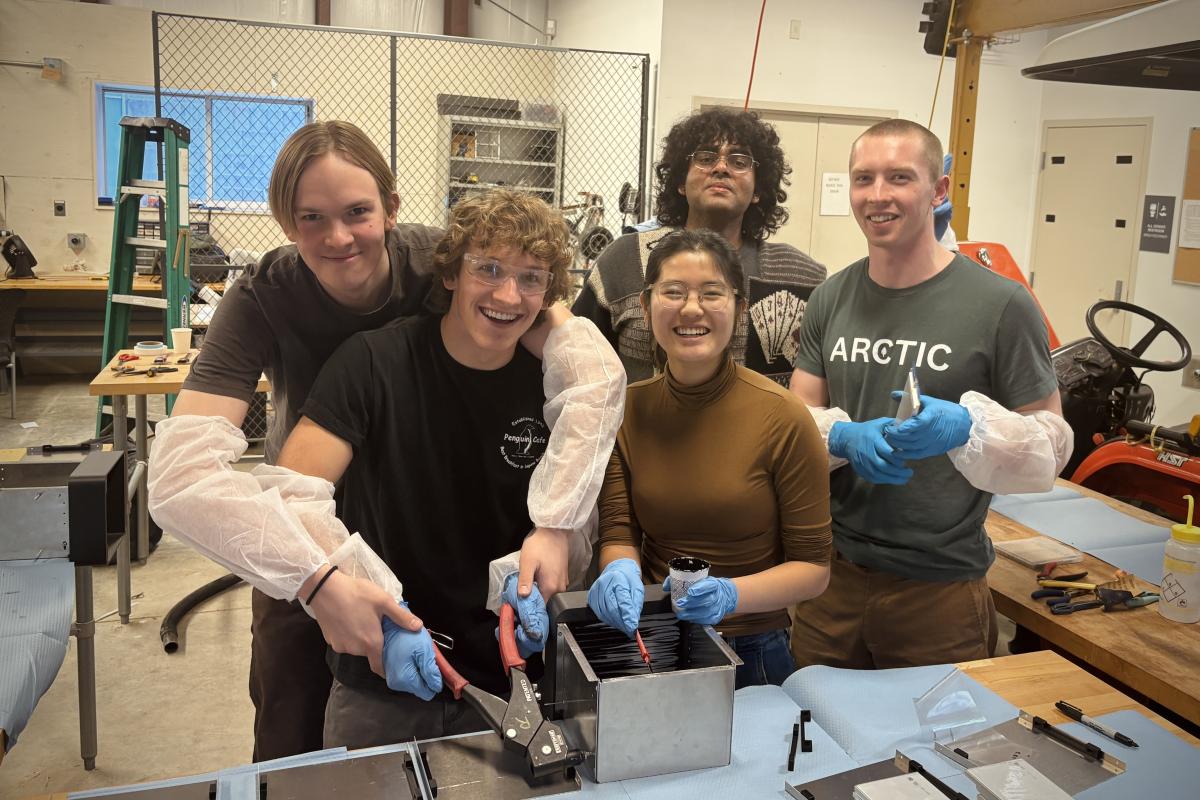
Members of the OCTAL team taking a group photo while building their drone's battery packs.
How Does OCTAL Work?
"Early on, we identified a niche: remote fires caused by lightning," says Walsh. "These fires are difficult to access, and they quickly grow to be very large and damaging. We learned it only takes about 200lbs of fire retardant to put them out if you can get on-site quick enough. OCTAL was designed around those requirements, and our interviews suggested a flying platform large enough to carry that magnitude of payload would be a huge assist for first responders and facilitate a major reduction in harm to the public, businesses, and wildlife."
Because wildfires are such a concern in the region, California continuously monitors for signs of fire using thousands of trail and infrared cameras, as well as satellites. OCTAL is designed to leverage that information by autonomously deploying to detected hotspots, performing an analysis with six visible and infrared-spectrum cameras, and releasing fire retardant to extinguish the fire or limit its spread.
"The goal with OCTAL is to create a network that, within ten to fifteen minutes, can put out a remote fire that firefighters otherwise wouldn't get to for an hour or more,” says Walsh. "A drone as powerful as ours has many other uses, too, like a search and rescue capability that could be lifesaving for first responders."
To Walsh's knowledge, OCTAL is the only autonomous vehicle of its kind under production at a college or university.
"This idea sounds absolutely ridiculous to 99.9 percent of people, but at Olin, that's kind of the norm," he says. "You get to have a level of imagination and freedom that I think you don't often see in an undergrad program. Instead of faculty explaining why something won’t work, they say, 'great, how can we help get you there?'"
"This idea sounds absolutely ridiculous to 99.9 percent of people, but at Olin, that's kind of the norm. You get to have a level of imagination and freedom that I think you don't often see in an undergrad program," says Ian Walsh '26, a member of the OCTAL team.
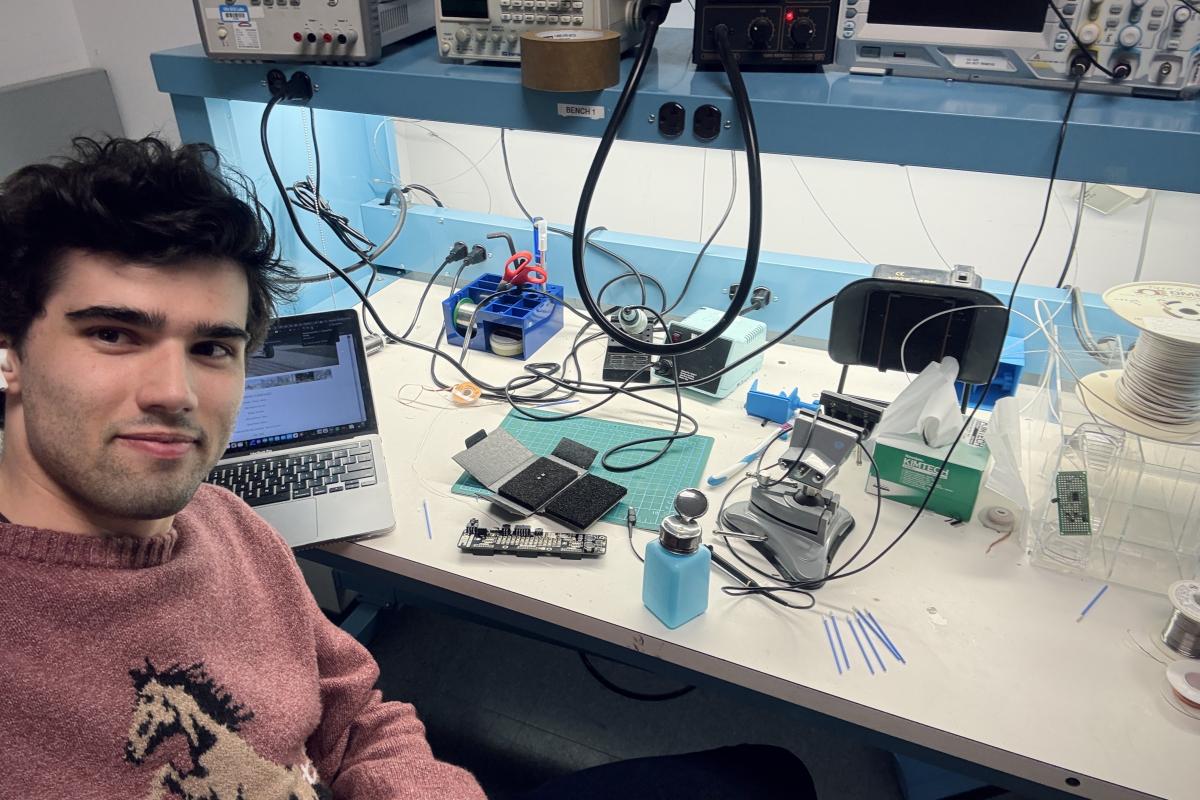
Project lead Ian Walsh '26 poses with the battery management system for the OCTAL team's drone.
Using Olin’s Resources for OCTAL
Walsh also credits on-campus resources like the Olin Shop for facilitating the detailed machining required to manufacture the drone's frame.
"Our team designed and built everything except the motors and their controllers in-house and from scratch. Fabricating the batteries, the frame, the flight electronics–that’s a tall order. We have quite a few first-years and sophomores on OCTAL, and they're already trained to use CNCs [Computer Numerical Control machines], the water jet, and welding tools," says Walsh. "The Shop staff were extraordinarily helpful and gave us great advice because they really want to see the drone come to life, too."
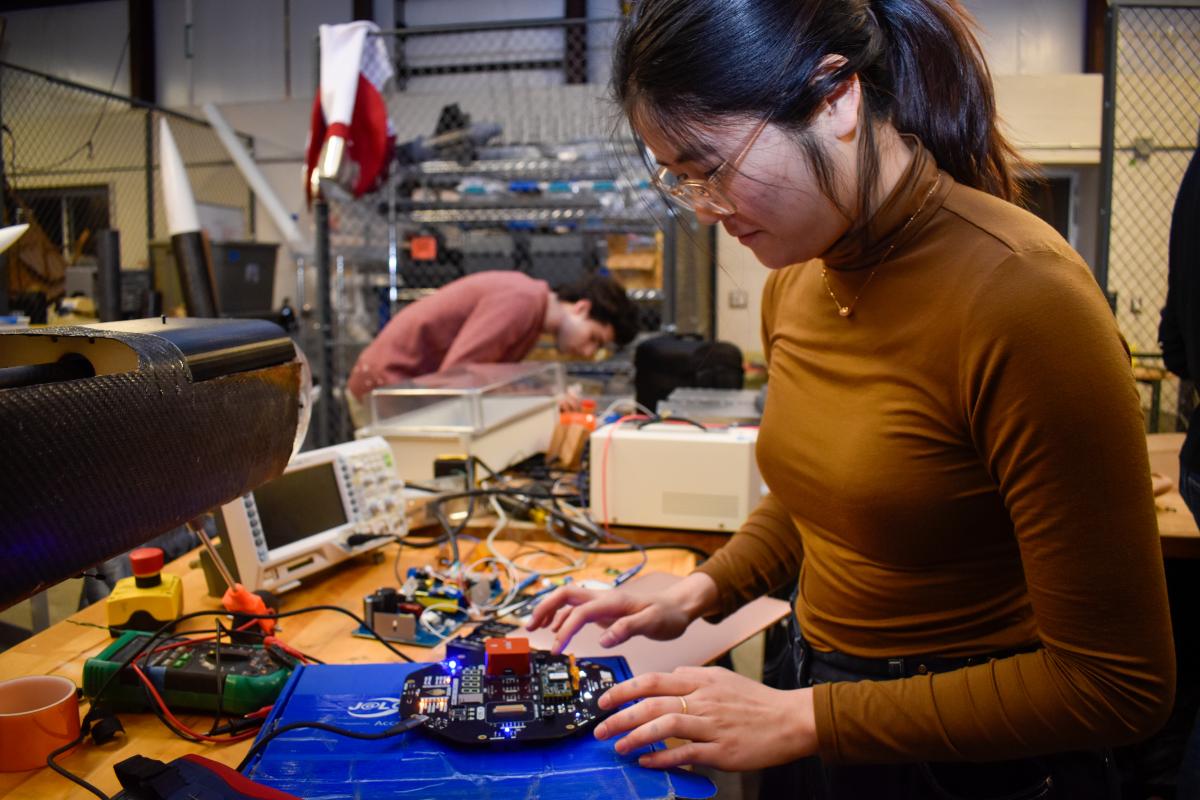
OCTAL team member Amanda Chang '26 debugs the drone's custom flight computer circuit board.
OCTAL was fully designed, fabricated, and bench-tested over the course of two semesters and began undergoing flight trials this spring. Even when faced with challenges, the project team has stuck together to create solutions—sometimes practically overnight.
"We ran an unpowered load test one night earlier in the semester, and six of our eight arms snapped off at an epoxied joint," says Walsh. "In that meeting, we diagnosed the problem and created a plan to reinforce them using stock material we had on hand. Logan Teeple '28, our mechanical lead, spent the entire next day manufacturing the replacement pieces. Within 48 hours, the arms were back together and about three times stronger. At Olin, you’re taught to be resilient."
After about a dozen tethered ground tests, the system flew for the first time on May 7, less than a day before most of the team left campus for the summer. A core group of members plans to reconvene in late June to continue work on OCTAL’s autonomous navigation and fire suppression capabilities.