Who Thrives at Olin College of Engineering?
Wondering if Olin College of Engineering is the right fit for your bachelor's degree?
Every college has its own culture. At Olin College of Engineering, the #3 undergraduate engineering college in the U.S. according to U.S. News & World Report, with #1 ranked professors and the #2 Best Classroom Experience, students come from many different backgrounds and pursue many different interests, but the students who thrive here often share several qualities.
If you enjoy asking questions, collaborating with others, bringing new ideas and prototypes to life, and making a meaningful impact, you may find yourself at home at Olin.
Start Your Journey to Olin
Receive information, emails, invitations to events, and other admission updates from Olin College by using the form linked below.
Request InformationStudents who thrive at Olin College of Engineering are often: Curious, Creative, Collaborative, Consequential, and Courageous.
There is no single formula for success at Olin. Students who thrive here come from many backgrounds and pursue many different interests through our three ABET-accredited bachelor's degrees, concentrations, and co-curriculars, but Olin students often share the qualities of curiosity, creativity, collaboration, a desire to make a meaningful impact, and the courage to embrace new challenges.
Curious
Students who thrive at Olin are often curious. They ask "What if?" and "Why not?"
Olin College of Engineering students enjoy asking questions, exploring new ideas, and learning how things work. Their interests often extend beyond engineering into design, entrepreneurship, the arts, humanities, and the social sciences. Olin College students are excited by discovery and motivated by the opportunity to keep learning.
Creative
Students who thrive at Olin are often creative. They turn ideas into new possibilities.
Olin College of Engineering students like imagining possibilities and bringing ideas to life. Oliners approach challenges with inventiveness, experiment and iterate with new approaches, and combine technical knowledge with design and human-centered thinking.
Creativity is a core part of engineering at Olin College. Students are challenged to ask better questions, rethink assumptions, and develop solutions that are both technically sound and meaningful for the people who will use them. From hands-on classroom projects to interdisciplinary experiences, creativity at Olin College of Engineering is treated as an essential engineering skill rather than an optional one.
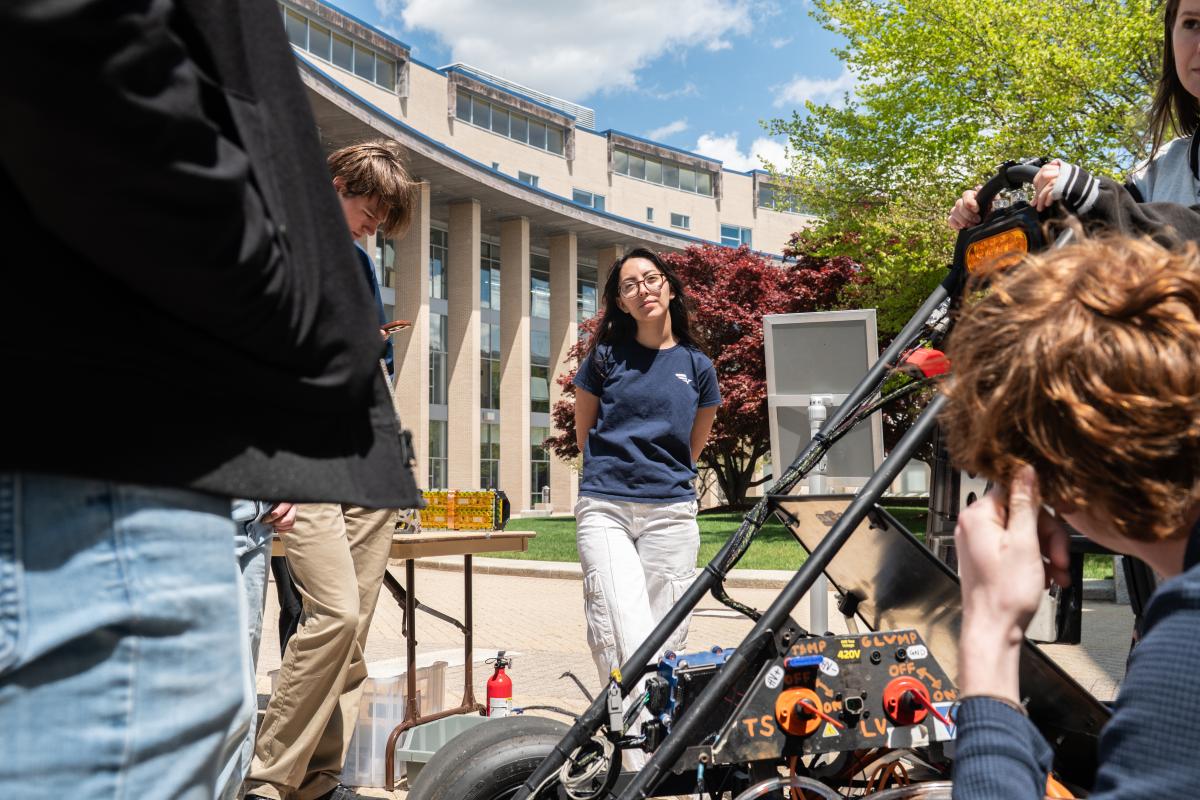
Alyssa Aranda '28, mechanical design lead, is shown demonstrating the Olin Electric Motorsports (OEM) Formula car, MK VII, during Spring Expo in May 2026.
Photo by Leise Jones.
Collaborative
Students who thrive at Olin College of Engineering are often collaborative. They know great work happens together.
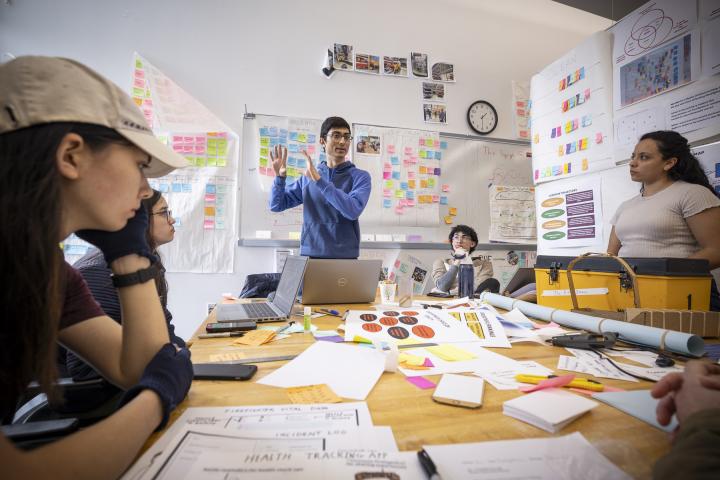
Olin students enjoy working with others and recognize that the best ideas often emerge from diverse teams. They value communication, empathy, and shared problem-solving, and are eager to learn from fellow Oliners with different perspectives and experiences.
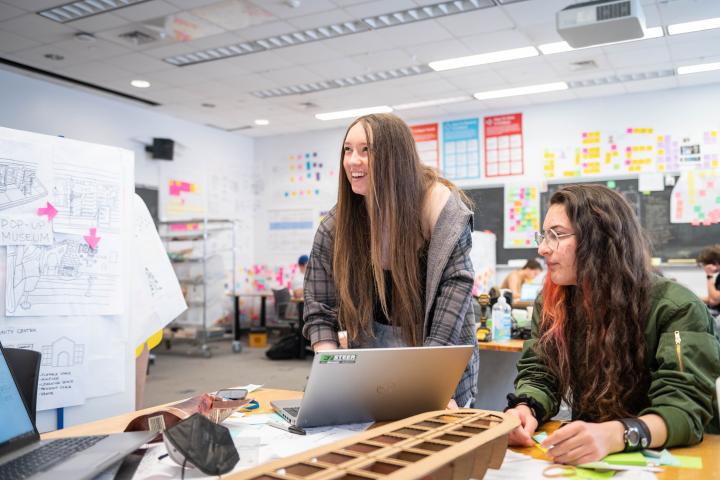
Olin College students begin working in teams during their first semester and continue collaborating through a variety of design courses, interdisciplinary projects, and the SCOPE capstone program.
Watch this video as Olin College of Engineering student, Trinity '28, and President R. May Lee talk about the collaborative nature of engineering at Olin.
Consequential
Students who thrive at Olin College are often consequential. They want to build things that matter.
Olin College of Engineering students want their work to make a difference. They are motivated by solving real problems, improving people's lives, and considering the broader social and ethical impacts of technology. Olin students care not only about what they can build, but why it matters.
That approach comes to life through hands-on engineering projects with real-world impact. In Olin's Design Justice Studio, students have collaborated with healthcare professionals and community partners to develop affordable, open-source technology that supports early hearing loss detection for children. By combining engineering, human-centered design, and close collaboration with stakeholders, Olin College of Engineering students are helping create consequential solutions that can improve access to care and make a meaningful difference in communities around the world.
Projects like these reflect how many Olin students think about engineering, not simply as a way to build new technologies, but as a way to improve people's lives.
Watch as Esther '26 shares how Oliners think about ethics in engineering and are working to change the world for the better.
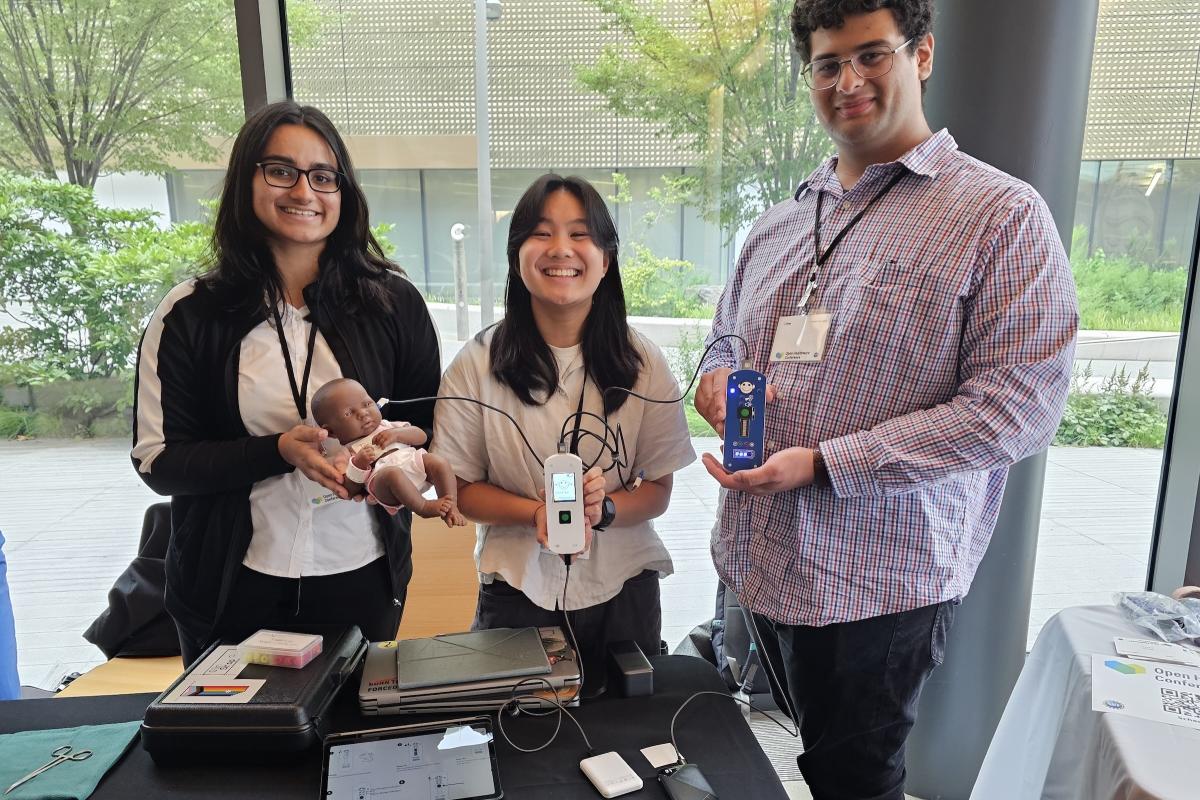
Olin researchers are pictured demonstrating their reprogrammable user interface prototypes that support early detection of hearing loss in children at the Open Healthware Conference in New York City.
(L to R): Antara Mazumdar '28, Arianne Fong '27, and Albert Manrique '25.
Courageous
Students who thrive at Olin are often courageous. They embrace uncertainty and keep moving forward.
Olin College students are willing to try unfamiliar things, embrace uncertainty, and tackle challenges without obvious answers. They understand that learning involves experimentation and iteration, and they see setbacks as opportunities to grow and improve.
At Olin, a Princeton Review 2025 Best Value College, students are encouraged to take intellectual risks. They often work on open-ended projects where there isn't a single "correct" solution, learning to adapt, persevere, and grow through feedback. Rather than avoiding failure, students learn that experimentation and iteration are essential parts of innovation and engineering.
What You'll Experience at Olin
Students at Olin don't just study engineering - they do real engineering from day one. Through hands-on, project-based learning, close collaboration with faculty, and real-world design challenges that provide the opportunity to embrace emerging technology and global challenges, students graduate with the experience and confidence to solve complex and meaningful problems.
Real Engineering
Hands-on, project-based learning begins in your first semester at Olin College of Engineering, with opportunities to design, build, test, and iterate throughout your time on campus.
Real Experience
At Olin College, you'll work alongside faculty, classmates, companies, nonprofits, and community partners on projects that address authentic engineering challenges like climate resilience, and provide the opportunity to embrace emerging technology.
Real Impact
Develop engineering solutions at Olin that improve lives, serve communities, and prepare you to make a meaningful difference long after graduation.
Olin College of Engineering is a Top 10 college for ROI on a bachelor’s degree
Receive information about Olin College of Engineering by filling out our contact form linked below. Complete it to receive emails, invitations to events, and other admission updates from Olin!
Request InformationThere Is No Single Type of Student Who Thrives at Olin
Is Olin College good for entrepreneurs?
Yes. Students interested in entrepreneurship often find Olin's project-based and interdisciplinary approach especially appealing. Olin students regularly combine engineering with design, business, and social impact, and many pursue ventures, product development, and innovation experiences alongside their technical studies.
Is Olin College good for students interested in design?
Yes. Design is woven throughout the Olin experience. Students learn to apply human-centered design principles, build prototypes, and iterate through projects that emphasize empathy, creativity, and understanding the needs of real users.
Is Olin College good for creative students?
Creativity is central to the Olin experience. Students are encouraged to experiment, explore ideas across disciplines, and bring together technical skills with interests in art, music, writing, storytelling, and other creative pursuits.
Is Olin College good for interdisciplinary students?
Olin College's curriculum intentionally connects engineering with entrepreneurship, arts, humanities, social sciences, and design. Students who enjoy exploring different fields and making connections between them often find Olin especially rewarding.
Do I have to know exactly what kind of engineer I want to be?
No. Many students arrive to Olin with broad interests and discover new passions through hands-on projects, collaboration, and experiences across disciplines. Curiosity and a willingness to learn are often more important than having a fixed career plan.
Check out our Admission blogs to hear directly from Olin students as they share their Olin experiences.
Do Olin College students work in teams?
Yes. Collaboration is a defining part of the Olin College of Engineering experience. Students spend much of their time learning alongside one another—brainstorming ideas, building prototypes, solving problems, and reflecting on what they've learned together. Teamwork begins in the first year and continues throughout the curriculum, from hands-on class projects to senior capstone experiences.
At Olin, students learn that great ideas rarely emerge from a single person working alone. They learn to listen, communicate, navigate differences, and draw on the diverse perspectives and strengths of their peers.
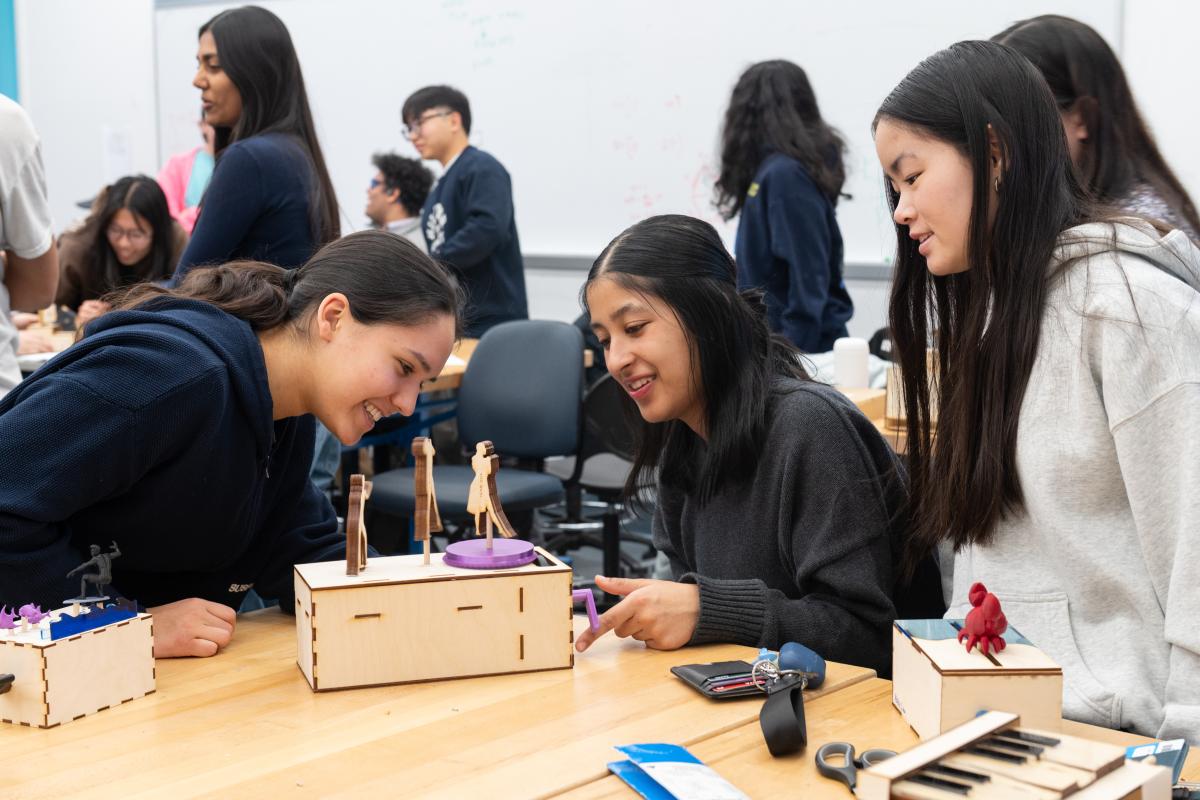
At Olin, students learn that great ideas rarely emerge from a single person working alone. They learn to listen, communicate, navigate differences, and draw on the diverse perspectives and strengths of their peers.
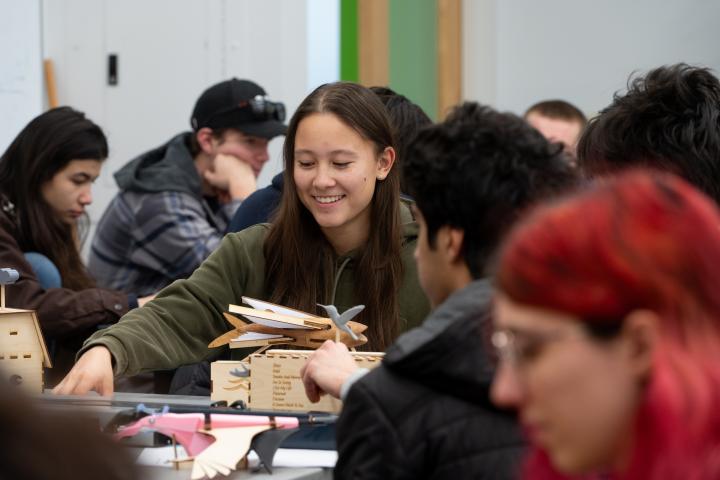
Pictured: Olin first-year students smile as they look at their automata project for Mechanical Prototyping (MechProto).
Can I combine engineering with art, music, writing, or other interests?
Yes. Olin students bring a wide range of interests to their engineering education. Many combine technical work with passions in art, music, writing, design, entrepreneurship, and the humanities. Rather than asking students to leave those interests behind, Olin encourages them to explore connections between disciplines and bring their whole selves to their work.
Oliners can even earn credits by taking AHSE0114 Olin Conductorless Orchestra.
The Olin Conductorless Orchestra (OCO) - an ensemble, minus conductor - features instrumentalists in leadership and collaborative roles. Dedicated to orchestral performance in the concerted spirit of chamber music, the orchestra forges individual participation, active listening, and group-motivation into performances that have established it as the only conductorless orchestra of its kind at an American college.
You Don't Need to Fit a Mold
Olin College of Engineering students are makers and musicians, coders and artists, entrepreneurs and researchers. Some arrive knowing exactly what they want to do, while others discover new passions along the way.
There is no single type of Olin student. What unites them is a desire to learn, create, collaborate, and make a difference!
Olin College: A Small, Elite, Engineering College Near Boston, MA

Enrolling the Class of 2031
We will enroll top students from all over the world for the Class of 2031. As always, we look for a multidimensional student body, representing a broad range of cultural, economic, and geographic backgrounds.
You may apply to Olin using the Common Application. We require you to submit the application, including Olin-specific questions, and application fee online through the Common Application website.
Please let us help you learn everything you need to know about our one-of-a-kind admission process, including important dates and deadlines and our admission requirements.